Switzerland is testing a faster regulatory pathway for selected clinical trials. The Swissmedic Fast-Track Pilot Project, run jointly with swissethics, combines shorter Swissmedic review targets with accelerated ethics review for eligible clinical trials with medicinal products
For sponsors, the practical impact is not limited to the number of days saved during review. The pilot makes early eligibility assessment, submission readiness, and coordination between Swissmedic and the ethics committee more important when planning study start-up.
Which clinical trials are eligible for fast-track review?
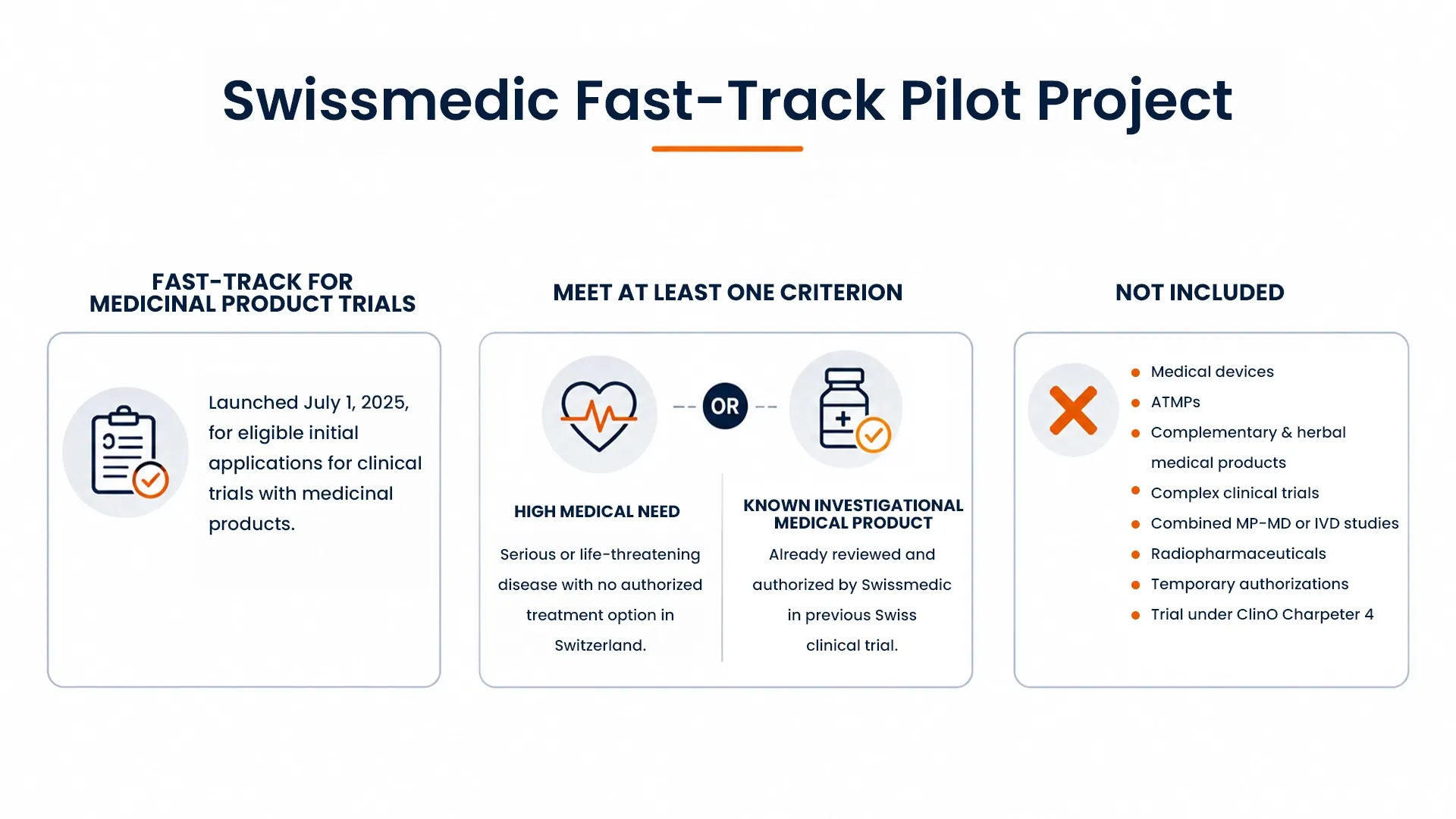
Swissmedic launched the Fast-Track Pilot Project on July 1, 2025 for eligible initial applications for clinical trials with medicinal products. The pilot focuses on trials addressing a high medical need or involving an investigational medicinal product already known to Swissmedic.
At least one of two criteria must be met:
- High medical need: the trial concerns a serious or life-threatening disease for which no authorized treatment option exists in Switzerland.
- Known investigational medicinal product: the active substance, combination of active substances, or investigational product has already been reviewed and authorized by Swissmedic in a previous Swiss clinical trial.
The fast-track procedure applies only to initial clinical trial applications. Amendments are not eligible.
Several types of clinical trials are also excluded, including trials involving medical devices, advanced therapy medicinal products (ATMPs), complementary and herbal medicinal products, complex clinical trials, combined medicinal-product and medical-device or in vitro diagnostic (IVD) studies, radiopharmaceuticals, temporary authorizations, and trials falling under ClinO Chapter 4.
For MedTech sponsors, this distinction is important: the current pilot does not provide a fast-track pathway for medical-device clinical investigations.
What actually changes in the Swissmedic timeline?
The main operational change is a shorter Swissmedic processing target for eligible applications.
For applications under Article 33 paragraph 2 of the Swiss Clinical Trials Ordinance (ClinO), Swissmedic targets 20 days instead of 30 days.
For applications under Article 33 paragraph 3, the target is 40 days instead of 60 days.
| Eligible Swissmedic application | Standard period | Fast-track target |
|---|---|---|
| ClinO Art. 33 para. 2 | 30 days | 20 days |
| ClinO Art. 33 para. 3 | 60 days | 40 days |
These are Swissmedic processing targets, not legally binding deadlines.
Swissmedic states that it will endeavor to meet them, but delays may still occur in exceptional circumstances.
Sponsors should therefore distinguish between a shorter regulatory target and a guaranteed study-start date. The fast-track timeline can support planning, but downstream milestones should still account for questions during review, ethics requirements, site readiness, contracting, and other study-start activities.
Swissethics makes coordinated planning more relevant
Accelerating Swissmedic review addresses only part of the authorization pathway. For studies requiring both Swissmedic authorization and ethics committee approval, the timing of both reviews matters.
Since May 2026, qualifying category B and C medicinal-product trials accepted for Swissmedic fast-track processing can also receive accelerated evaluation by the competent ethics committee.
The sponsor indicates the Swissmedic FAST-Track request when submitting the clinical trial project through the Business Administration System for Ethics Committees (BASEC).
This creates a more coordinated pathway, but it also means that sponsors need to think about the two submissions together.
In practice, teams should consider:
- whether the study meets Swissmedic fast-track eligibility criteria;
- whether a Swissmedic preassessment is required;
- when the Swissmedic and BASEC submissions should be made;
- whether information is consistent across the regulatory packages;
- who is responsible for each submission and authority interaction; and
- whether the study team can respond efficiently to questions during review.
The benefit of an accelerated pathway is easier to use when regulatory activities are planned as one process rather than as separate submissions.
The two eligibility routes require different preparation
Swissmedic fast-track eligibility should be assessed before the clinical trial application is ready for submission because the process differs depending on the eligibility criterion.
For trials based on high medical need, sponsors must first request a preassessment from Swissmedic. The request includes the Fast Track application form, an accompanying letter, and the protocol synopsis. Swissmedic then assesses whether the high-medical-need criterion is fulfilled.
For a known investigational medicinal product, prior preassessment is not required. The Fast Track application form can be submitted with the clinical trial application, and Swissmedic assesses eligibility during formal review.
| Regulatory question | High medical need | Known investigational medicinal product |
|---|---|---|
| Basis for eligibility | Serious or life-threatening disease with no authorized treatment option in Switzerland | Product or relevant substance previously reviewed and authorized in a Swiss clinical trial |
| Preassessment | Required | Not required |
| Timing | Before the main clinical trial application | With the clinical trial application |
| Main preparation point | Support the eligibility rationale | Confirm previous Swiss regulatory history |
For regulatory teams, this means fast-track eligibility should be part of submission planning, not a final administrative check before filing.
Consider a sponsor planning a category C trial that may qualify because of high medical need. Waiting until the full clinical trial application is ready before assessing fast-track eligibility could create unnecessary sequencing issues because Swissmedic preassessment is required first.
An earlier assessment allows the regulatory team to incorporate that step into the submission plan from the beginning.
Faster review does not mean fewer regulatory requirements
The Fast-Track Pilot Project changes the targeted processing time, not the regulatory standard applied to the application.
Swissmedic states that participant safety remains central and that the applicable regulatory requirements continue to apply.
For sponsors, this makes submission readiness particularly important. A compressed review target leaves little value in obtaining fast-track status if the dossier contains inconsistencies or issues that require additional clarification.
Before submission, regulatory teams should confirm that:
- the fast-track eligibility rationale is adequately supported;
- the protocol and supporting documents are aligned;
- Swissmedic and ethics submissions contain consistent information;
- required documentation is complete;
- internal responsibilities for authority questions are clear; and
- clinical and operational teams are working from the same regulatory timeline.
Consider a study in which the Swissmedic package and ethics submission are prepared by different teams. Even when both submissions are individually complete, differences in study descriptions, document versions, or planned procedures can create questions that need to be resolved.
The practical objective is therefore not simply to submit quickly. It is to enter the accelerated review pathway with a coordinated package.
What the Swissmedic Fast-Track Pilot Project means for medical-device sponsors
Medical-device clinical investigations are not currently eligible for the Swissmedic fast-track procedure.
Combined medicinal-product and medical-device or IVD trials are also excluded.
Medical-device sponsors should therefore continue to plan their Swiss clinical investigations according to the applicable medical-device regulatory and ethics pathways.
The pilot is still relevant to regulatory teams working in MedTech. It shows that Swissmedic and swissethics are testing ways to make clinical trial review more efficient while maintaining regulatory and ethical oversight.
Swissmedic has indicated that the pilot is planned through the end of 2026. A permanent implementation would require a legal basis, with a possible legislative change no earlier than 2027.
There is currently no basis to assume that the fast-track pathway will be extended to medical devices. Sponsors should follow developments without building future device-study timelines around an extension that has not been announced.
What sponsors should do now
For eligible medicinal-product trials, the Swissmedic Fast-Track Pilot Project gives regulatory teams another pathway to consider during study planning.
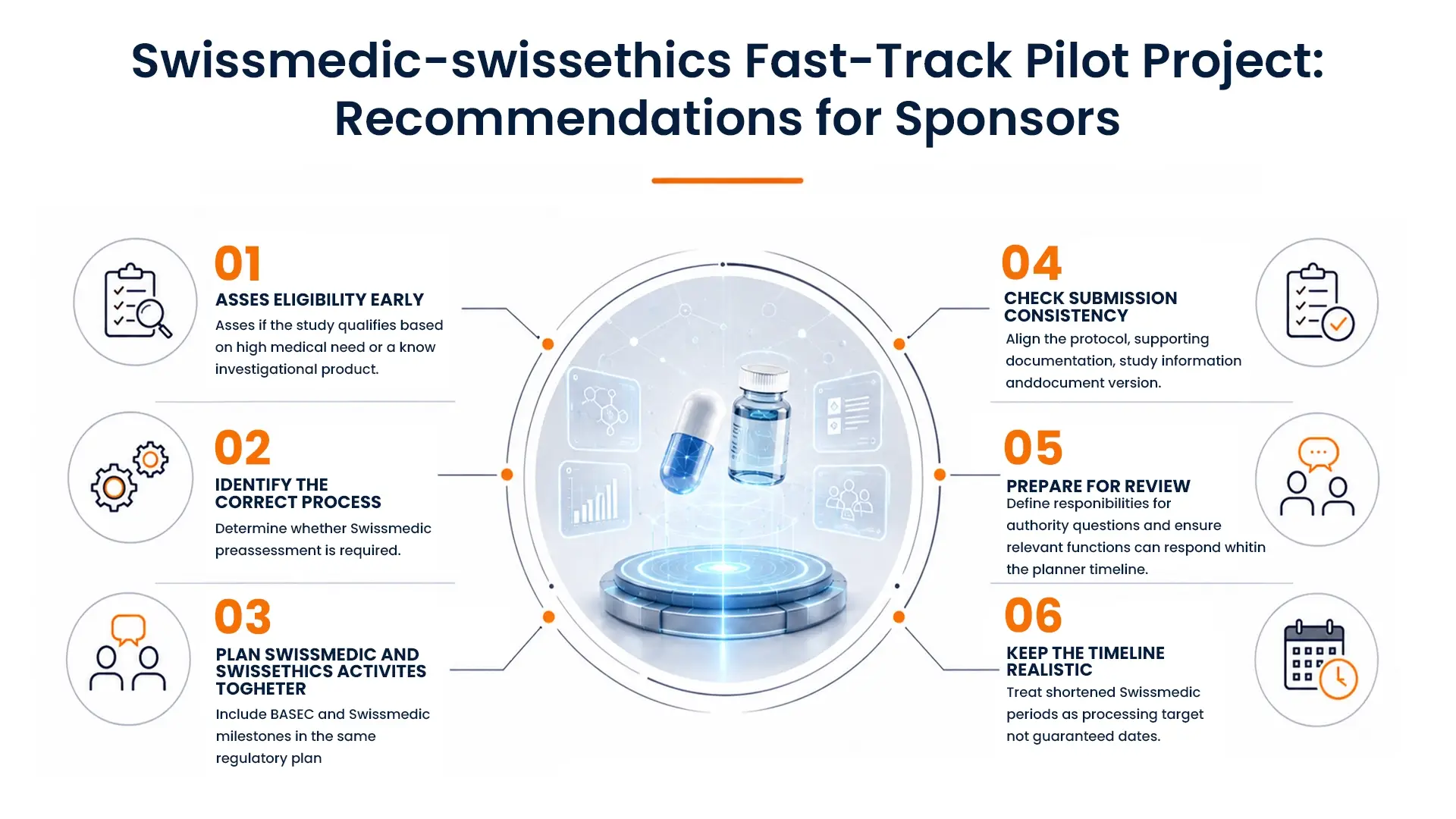
A practical approach is to:
- Assess eligibility early. Determine whether the study may qualify based on high medical need or a known investigational medicinal product.
- Identify the correct process. Establish whether Swissmedic preassessment is required.
- Plan Swissmedic and ethics activities together. Include BASEC and Swissmedic milestones in the same regulatory plan.
- Check submission consistency. Align the protocol, supporting documentation, study information, and document versions across submissions.
- Prepare for review. Define responsibilities for authority questions and make sure relevant functions can respond within the planned timeline.
- Keep the timeline realistic. Treat the shortened Swissmedic periods as processing targets, not guaranteed authorization dates.
For sponsors planning Swissmedic clinical trials, regulatory strategy increasingly involves coordinating requirements, documentation, and timelines across authorities, internal study functions, and the clinical trial authorisation pathway in Switzerland.
Meditrial’s Regulatory Affairs services can support sponsors with regulatory strategy, submission planning, documentation, and regulatory coordination as part of the broader clinical development program.
The Swiss fast-track pilot creates a useful opportunity for eligible studies, but using it effectively starts before submission. Contact Meditrial to discuss the regulatory pathway and submission strategy for your clinical development program in Switzerland.
Frequently Asked Questions
What is the Swissmedic Fast-Track Pilot Project?
The Swissmedic Fast-Track Pilot Project is an accelerated processing pathway for eligible initial applications for clinical trials with medicinal products. It started on July 1, 2025 and covers qualifying trials involving high medical need or investigational medicinal products already known to Swissmedic. The underlying regulatory and participant-safety requirements remain applicable.
How much faster is Swissmedic fast-track review?
Swissmedic targets 20 days instead of 30 days for eligible applications under ClinO Article 33 paragraph 2 and 40 days instead of 60 days for applications under paragraph 3. These are processing targets rather than legally binding deadlines, and exceptional delays may still occur.
What role does swissethics play in the fast-track pathway?
Since May 2026, qualifying category B and C medicinal-product trials accepted for Swissmedic fast-track processing can also undergo accelerated evaluation by the competent ethics committee. Sponsors identify the Swissmedic FAST-Track request when submitting the clinical trial project through BASEC.
Are medical-device clinical investigations eligible for Swissmedic fast-track review?
No. The current Swissmedic Fast-Track Pilot Project excludes clinical trials involving medical devices. Combined medicinal-product and medical-device or IVD trials are also excluded. Medical-device sponsors should continue to follow the applicable Swiss regulatory pathway for clinical investigations.
Does fast-track review reduce Swiss regulatory requirements?
No. Fast-track review changes the targeted processing time, not the regulatory requirements applied to the application. Swissmedic continues to assess participant safety and compliance with applicable requirements. Sponsors therefore still need a complete and consistent clinical trial application.
How should sponsors prepare for a Swiss fast-track submission?
Sponsors should assess eligibility early, determine whether preassessment is required, coordinate Swissmedic and BASEC activities, and check consistency across the submission packages. Internal teams should also be prepared to manage authority questions efficiently and incorporate the shortened processing targets into a realistic overall study-start timeline.
Sources
- Swissmedic, Submission of applications, Fast-Track Pilot Project. Official eligibility criteria, exclusions, submission procedures and processing targets.
- Swissmedic, Faster processing of applications for clinical trials, June 27, 2025. Official announcement of the pilot and its objectives.
- Swissmedic, Clinical trials on medicinal products. Official notice confirming the July 1, 2025 launch of the pilot.
- Swissmedic, Clinical trials on medicinal products, 2026 update. Official information on accelerated ethics review for qualifying category B and C applications from May 2026.
- swissethics, BASEC Submission Portal. Official May 1, 2026 notice regarding the fast-track pilot and submission pathway.
- Swissmedic, Clinical trials with medical devices. Current Swissmedic resources for medical-device clinical investigations.
Table of Contents
- Which clinical trials are eligible for fast-track review?
- What actually changes in the Swissmedic timeline?
- Swissethics makes coordinated planning more relevant
- The two eligibility routes require different preparation
- Faster review does not mean fewer regulatory requirements
- What the Swissmedic Fast-Track Pilot Project means for medical-device sponsors
- What sponsors should do now
- Frequently Asked Questions
- Sources
Latest Articles
A Confident UK Device Launch Starts With Your MHRA Strategy
Registering a medical device with the Medicines and Healthcare [...]
A Clearer Global Regulatory Strategy for Medical Device Launches
The order in which a device enters its markets [...]
Practical 510(k) vs PMA vs De Novo FDA Pathway Guide
Practical 510(k) vs PMA vs De Novo guidance for choosing an FDA device pathway based on classification, predicates, risk, and evidence needs
This article provides general information and does not constitute regulatory, legal, clinical, or compliance advice. Requirements and appropriate processes may vary by study, product, jurisdiction, and organization. Medigen Suite functionality should be used in accordance with applicable regulations, study documentation, and internal procedures.