
MDCG 2025-9 gives highly innovative device developers a clearer framework for navigating regulatory development in Europe, but breakthrough device designation is not a shortcut around the EU Medical Device Regulation (MDR). For EU breakthrough medical devices, the opportunity lies instead in earlier regulatory interaction, prioritization, and a more explicitly lifecycle-based approach to clinical evidence.
Published in December 2025, the Medical Device Coordination Group (MDCG) guidance establishes recommendations for breakthrough medical devices and in vitro diagnostic medical devices under the MDR and In Vitro Diagnostic Medical Devices Regulation (IVDR). Its objective is to facilitate timely patient access while maintaining the clinical evidence requirements applicable to these technologies.
MDCG 2025-9 Creates a Framework for Breakthrough Device Development
The concept behind MDCG 2025-9 addresses a recurring challenge in medical device innovation: highly novel technologies may have substantial potential clinical value while also presenting greater uncertainty because established standards, comparators, clinical experience, or long-term evidence may be limited.
The guidance therefore seeks a proportionate balance. It describes how pre-market evidence and post-market evidence can be considered across the device lifecycle while maintaining requirements for safety, performance, and clinical benefit. Importantly, breakthrough status can be considered relatively early in development, before market access.
A breakthrough device designation does not provide market exclusivity, waive MDR or IVDR requirements, or itself constitute CE marking. Multiple devices addressing similar intended purposes may receive breakthrough status, and manufacturers remain responsible for demonstrating conformity with the applicable regulatory requirements.
MDCG 2025-9 may apply across technologies and device risk classes. Custom-made devices, in-house devices, and products listed in MDR Annex XVI without an intended medical purpose fall outside its scope.
Which Devices Can Qualify as EU Breakthrough Medical Devices?
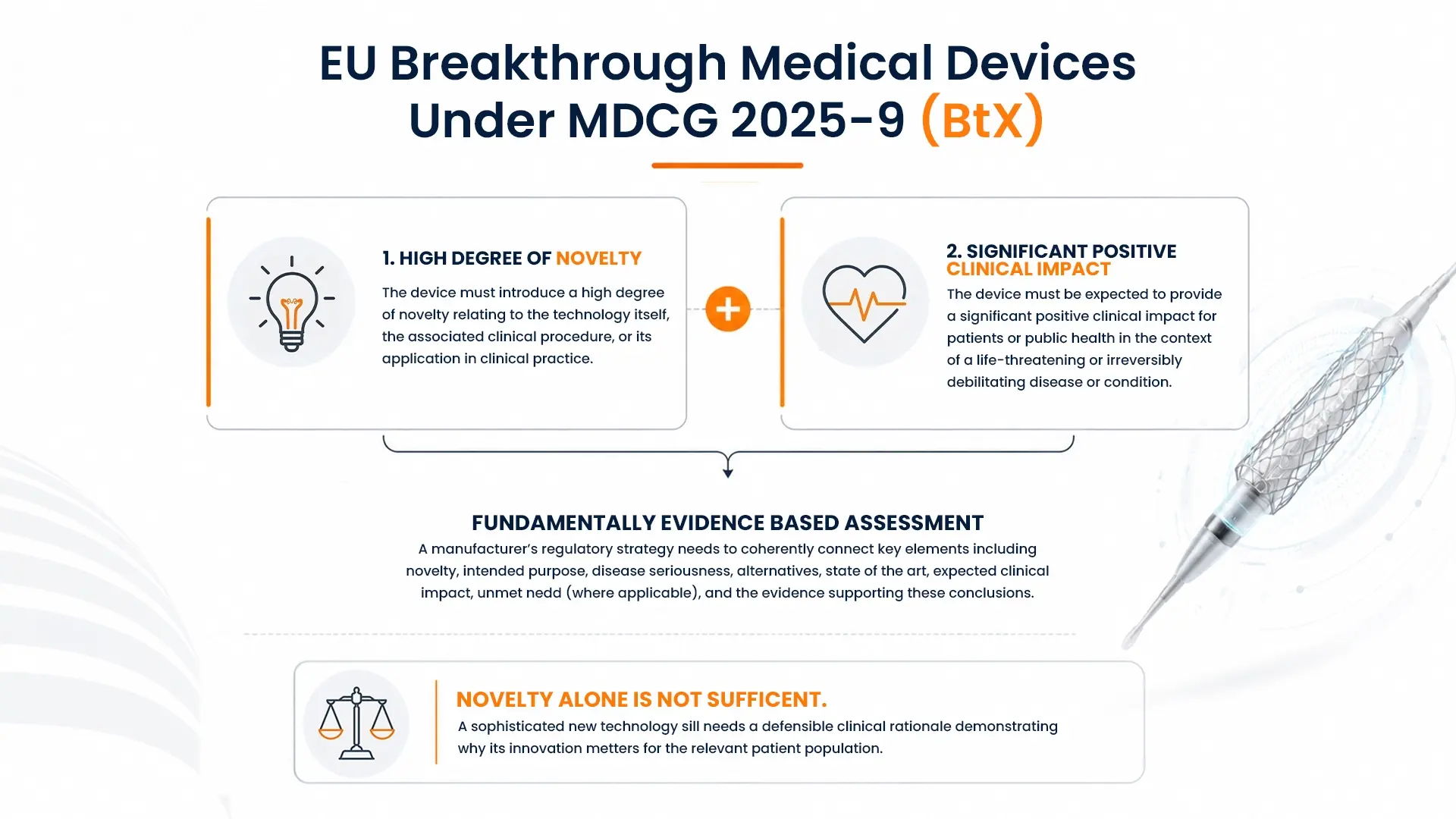
MDCG 2025-9 establishes two core criteria, and a device must meet both.
First, the device must introduce a high degree of novelty relating to the technology itself, the associated clinical procedure, or its application in clinical practice.
Second, it must be expected to provide a significant positive clinical impact for patients or public health in the context of a life-threatening or irreversibly debilitating disease or condition. That impact may arise because the device offers a significant improvement compared with available alternatives and the state of the art, or because it addresses an unmet medical need where adequate alternatives are absent or insufficient.
This makes the breakthrough assessment fundamentally evidence based. A manufacturer’s regulatory strategy needs to connect several elements coherently:
- the nature and degree of technological or clinical novelty;
- the intended purpose and target population;
- the seriousness of the disease or condition;
- current treatment or diagnostic alternatives;
- the relevant state of the art;
- the expected clinical impact;
- the unmet medical need, where applicable; and
- the evidence supporting these conclusions.
Novelty alone is therefore not sufficient. A sophisticated new technology still needs a defensible clinical rationale demonstrating why its innovation matters for the relevant patient population.
For regulatory teams, this places early state-of-the-art assessment, intended-purpose definition, clinical claims, and evidence planning at the center of breakthrough device strategy.
Breakthrough Device Designation Creates Opportunities for Earlier Regulatory Interaction
One of the most consequential aspects of MDCG 2025-9 is the opportunity for structured interaction with expert panels.
To obtain breakthrough status, manufacturers submit a breakthrough status request to the expert panels established under MDR Article 106 for an opinion on whether the device meets the breakthrough criteria. A request can be made at any point in development when sufficient evidence exists to substantiate those criteria.
The guidance states that expert panels will endeavor to issue an opinion on breakthrough status within 60 days and prioritize these applications.
Once a device has received a positive breakthrough opinion, the manufacturer may submit a separate advice request. EMA provides separate templates for the breakthrough status request and the advice request.
For class III devices and class IIb active devices intended to administer or remove a medicinal product, manufacturers may request early scientific advice under MDR Article 61(2). This can address the intended clinical development strategy, clinical investigation proposals, and relevant post-market clinical follow-up activities.
The regulatory value is potentially significant. Expert interaction can occur while the evidence-generation strategy is still being shaped, rather than only after pivotal development decisions have been made.
However, obtaining advice is not the same as transferring regulatory responsibility to the expert panel. Manufacturers need to formulate focused scientific and methodological questions, consider the advice received, and document how that advice has been addressed in the clinical evaluation report.
Clinical Evidence Is Rebalanced, Not Reduced
Perhaps the most important strategic message in MDCG 2025-9 is its treatment of clinical evidence.
The guidance does not remove the need for robust clinical evidence. Instead, it recognizes that evidence generation for a genuinely novel technology may need to be planned across the full device lifecycle.
For breakthrough medical devices, clinical investigations are expected to remain a key source of pre-market evidence. Implantable and class III breakthrough medical devices remain subject to the clinical investigation requirements of MDR Article 61(4).
The guidance recognizes that pre-market investigations may focus on safety together with short-term and medium-term performance where this provides sufficient evidence for timely access. Remaining questions may then require confirmation through post-market clinical investigations and other post-market clinical follow-up (PMCF) activities.
That approach makes the clinical development plan particularly important.
Under MDR Annex XIV, the clinical evaluation plan already forms part of a continuous clinical evaluation process and includes a clinical development plan progressing from exploratory investigations through confirmatory investigations and PMCF.
For a breakthrough device, those stages may become even more interconnected.
| Regulatory question | Strategic consideration under MDCG 2025-9 |
|---|---|
| Does the device qualify? | Demonstrate both high novelty and significant expected clinical impact |
| When should designation be considered? | When sufficient evidence exists to support the criteria and regulatory input can still inform development |
| What is needed before market access? | Sufficient evidence to support safety, performance, clinical benefit, and conformity |
| Can evidence continue post-market? | Yes, where appropriately justified and supported by robust PMS and PMCF planning |
| Does breakthrough status replace CE marking? | No. Applicable MDR or IVDR conformity assessment requirements remain |
| What becomes more important? | Integrated regulatory, clinical, risk management, and lifecycle evidence planning |
The implication for sponsors is that a breakthrough strategy should not be developed independently from the clinical evidence strategy. Decisions about endpoints, comparator selection, patient population, follow-up duration, risk characterization, and post-market evidence can influence both the credibility of the designation request and the subsequent conformity assessment pathway.
Notified Body Prioritization Could Improve Regulatory Predictability
MDCG 2025-9 also addresses how notified bodies should approach designated breakthrough devices.
The guidance recommends that notified bodies prioritize breakthrough files in planning and resource allocation, engage manufacturers in early and structured dialogue, and coordinate with expert panels where appropriate. Topics for dialogue can include clinical evidence generation, study design, usability, post-market surveillance, and PMCF strategy.
MDCG 2025-9 also addresses cost and access for smaller developers. It states that notified bodies should keep breakthrough-device fee structures and processes transparent and proportionate for SMEs, and highlights complementary EU and national funding mechanisms that may support manufacturers during development, including the EU4Health Programme and the European Innovation Council (EIC) Accelerator.
This does not guarantee a particular assessment timeline or certification outcome. It does, however, create a framework intended to improve coordination and predictability for qualifying technologies.
MDCG 2025-9 also recognizes the possibility of certification with specific conditions or provisions when available pre-market evidence is considered sufficient but requires subsequent completion or confirmation. Such conditions may include defined PMCF activities, specified milestones, enhanced surveillance, or periodic reporting.
The trade-off is important. A lifecycle evidence approach can support earlier access where justified, but it can also create substantial post-market commitments.
Failure to meet binding conditions attached to certification may ultimately affect certificate validity, including possible suspension or withdrawal.
Regulatory Strategy Must Now Extend Further Into the Device Lifecycle
For breakthrough technologies, post-market evidence is not an administrative afterthought.
MDCG 2025-9 emphasizes comprehensive post-market surveillance and PMCF or post-market performance follow-up for IVDs. These activities can be used to characterize rare or latent risks, confirm longer-term performance, and address evidence uncertainties that could not be fully resolved before conformity assessment.
Notified bodies are also expected to reassess updated clinical evaluation reports and PMCF or PMPF results at a frequency proportionate to clinical risk and monitor compliance with conditions associated with certification.
For manufacturers, this shifts the regulatory planning question from simply “What evidence do we need for CE marking?” toward “What evidence do we need before CE marking, what uncertainty can appropriately remain, and how will we resolve it after market access?”
That distinction can influence study architecture, data collection, budgets, registries, PMCF investigations, regulatory documentation, and internal resourcing well before conformity assessment begins.
The EU Is Moving Toward a Legal Framework for Breakthrough Devices
MDCG 2025-9 is guidance, but the EU is also moving toward formally recognizing breakthrough devices in legislation.
In December 2025, the European Commission proposed amendments to the MDR and IVDR that would introduce breakthrough device provisions through a new MDR Article 52a and IVDR Article 48a. The proposal includes priority conformity assessment and, where appropriate, rolling review, as well as opportunities for early expert panel advice on clinical development and evidence generation.
For sponsors, these provisions could have practical implications. Rolling review could allow parts of the conformity assessment documentation to be assessed as they become available, while earlier expert engagement could inform evidence planning during development.
The proposal is not currently applicable law, and its final content remains subject to the EU legislative process. The process has nevertheless advanced: in early July 2026, the Rapporteur in the European Parliament’s Committee on Public Health published a draft report containing over 130 suggested amendments, followed by a July 20 deadline for parliamentary amendments. Technical meetings are expected in the autumn, with a plenary vote expected toward or shortly after the New Year, when Parliament would formally adopt its position.
For manufacturers, this legislative direction adds strategic relevance to the current MDCG 2025-9 framework. Breakthrough status could ultimately become embedded in the MDR and IVDR, with dedicated conformity assessment mechanisms for qualifying devices.
Building a Regulatory Strategy Around MDCG 2025-9
The European Medicines Agency (EMA) is implementing MDCG 2025-9 through a phased pilot program. As of August 2026, Phase Ia is closed to new breakthrough status requests, while Phase Ib opens for submissions on September 1, 2026, covering class III medical devices and class IIb active devices intended to administer or remove medicinal products.
EMA expects Phase II to begin in Q1 2027, extending designation and advice requests to all classes of medical devices, followed by Phase III in Q3 2027 for in vitro diagnostic medical devices (IVDs). EMA notes that information on the pilot phases is subject to change.
For manufacturers considering this pathway, regulatory preparation can start before submitting a designation request.
A practical sequence is to:
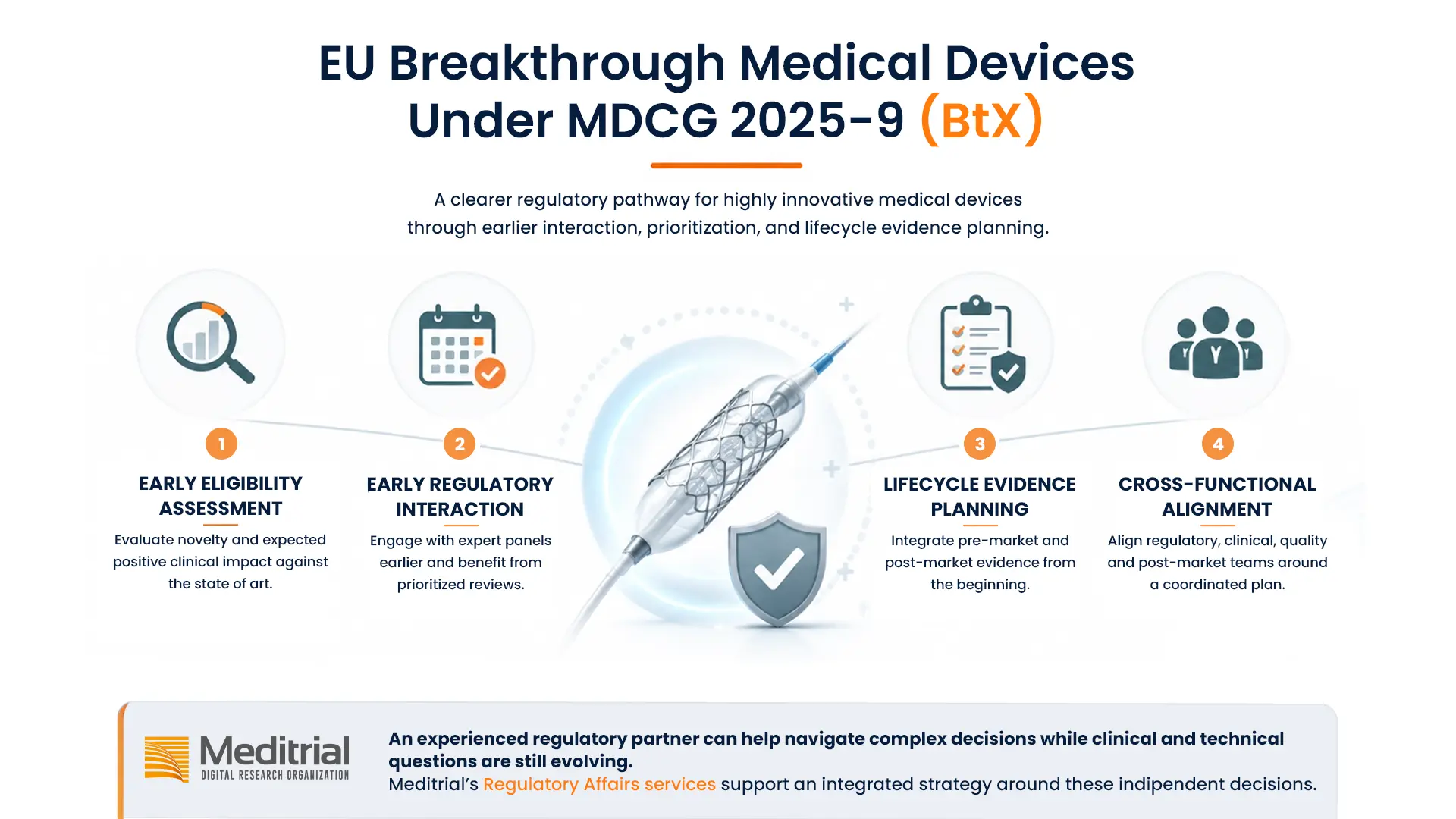
- Assess eligibility early. Determine whether both novelty and positive clinical impact can be substantiated against the current state of the art.
- Identify evidence gaps. Separate uncertainties that need resolution before designation, before conformity assessment, and after market access.
- Align claims and evidence. Ensure the intended purpose, clinical benefits, target population, and proposed evidence-generation program tell a consistent regulatory story.
- Plan expert engagement strategically. Identify specific questions where early advice could meaningfully inform clinical development.
- Design PMCF from the beginning. Treat post-market evidence as part of the clinical development strategy rather than a downstream compliance activity.
- Maintain cross-functional alignment. Regulatory, clinical, risk management, quality, and post-market teams should work from a coordinated lifecycle evidence plan.
For developers of complex or highly innovative medical devices, these activities can require regulatory decisions to be made while important clinical and technical questions are still evolving.
An experienced regulatory partner can support eligibility assessment, state-of-the-art analysis, regulatory pathway planning, expert panel preparation, clinical evidence strategy, and alignment of pre-market and post-market requirements. Meditrial’s Regulatory Affairs services can support medical device manufacturers in developing an integrated strategy around these interdependent decisions.
A New Opportunity for High-Impact Medical Device Innovation in Europe
MDCG 2025-9 represents a constructive development for medical device innovators seeking a more structured European pathway for technologies addressing serious clinical needs. Its value is not an exemption from regulatory rigor, but a framework for earlier dialogue, prioritization, proportionate evidence planning, and greater coordination across development and conformity assessment.
Manufacturers that believe their technology could qualify should consider breakthrough eligibility alongside their broader EU regulatory and clinical development strategy rather than treating designation as a standalone milestone. Meditrial can support sponsors in evaluating the regulatory pathway and building an evidence strategy aligned with MDR requirements and MDCG 2025-9.
Frequently Asked Questions
What is an EU breakthrough medical device under MDCG 2025-9?
An EU breakthrough medical device is a device meeting the MDCG 2025-9 criteria for both a high degree of novelty and significant expected positive clinical impact in a life-threatening or irreversibly debilitating disease or condition. The clinical impact can derive from an improvement over available alternatives or from addressing an unmet medical need.
Does breakthrough device designation accelerate CE marking?
Breakthrough designation does not replace or guarantee CE marking. MDCG 2025-9 provides mechanisms intended to facilitate timely development and assessment, including expert advice, prioritization by notified bodies, and structured dialogue, while applicable MDR or IVDR conformity requirements remain in place.
Does MDCG 2025-9 reduce clinical evidence requirements?
MDCG 2025-9 does not establish a general waiver of clinical evidence requirements. It supports a proportionate lifecycle approach in which sufficient pre-market evidence may, where justified, be complemented by structured post-market evidence generation. Clinical investigations remain particularly important for novel breakthrough technologies.
When should a manufacturer apply for breakthrough device designation?
A manufacturer may seek an expert panel opinion on breakthrough status at any stage of development once sufficient evidence exists to support the MDCG 2025-9 criteria. Earlier engagement may be particularly useful when scientific advice can still influence the clinical development and evidence-generation strategy.
What role does PMCF play for breakthrough medical devices?
Post-market clinical follow-up can be particularly important when questions about longer-term performance, rare risks, or other uncertainties remain after conformity assessment. MDCG 2025-9 emphasizes comprehensive PMCF planning and allows specific post-market activities and milestones to form part of certification conditions where appropriate.
Is the MDCG 2025-9 breakthrough pathway already available to all medical devices?
Not yet through the EMA pilot. As of August 2026, Phase I covers class III devices and class IIb active devices intended to administer or remove medicinal products. EMA expects Phase II to extend the pilot to all medical device classes in Q1 2027 and Phase III to IVDs in Q3 2027, although these plans remain subject to change.
Can a breakthrough device also be an orphan device?
Yes. MDCG 2025-9 confirms that a device may qualify as both a breakthrough device and an orphan device under MDCG 2024-10, and that the two guidance documents can be applied together where relevant, which is particularly useful for high-need conditions affecting small, defined patient populations.
Sources
- MDCG 2025-9: Guidance on Breakthrough Devices (BtX) under Regulations (EU) 2017/745 & 2017/746
- Regulation (EU) 2017/745 on Medical Devices (EU MDR)
- EMA Expert Panel Support for Breakthrough Medical Devices: Pilot Programme
- European Commission MDCG Guidance Repository
- European Commission Proposal COM(2025) 1023 amending the MDR and IVDR
Table of Contents
- MDCG 2025-9 Creates a Framework for Breakthrough Device Development
- Which Devices Can Qualify as EU Breakthrough Medical Devices?
- Breakthrough Device Designation Creates Opportunities for Earlier Regulatory Interaction
- Clinical Evidence Is Rebalanced, Not Reduced
- Notified Body Prioritization Could Improve Regulatory Predictability
- Regulatory Strategy Must Now Extend Further Into the Device Lifecycle
- The EU Is Moving Toward a Legal Framework for Breakthrough Devices
- Building a Regulatory Strategy Around MDCG 2025-9
- A New Opportunity for High-Impact Medical Device Innovation in Europe
- Frequently Asked Questions
- Sources
Latest Articles

A Confident UK Device Launch Starts With Your MHRA Strategy
Registering a medical device with the Medicines and Healthcare [...]

A Clearer Global Regulatory Strategy for Medical Device Launches
The order in which a device enters its markets [...]
Practical 510(k) vs PMA vs De Novo FDA Pathway Guide
Practical 510(k) vs PMA vs De Novo guidance for choosing an FDA device pathway based on classification, predicates, risk, and evidence needs
This article provides general information and does not constitute regulatory, legal, clinical, or compliance advice. Requirements and appropriate processes may vary by study, product, jurisdiction, and organization. Medigen Suite functionality should be used in accordance with applicable regulations, study documentation, and internal procedures.