Practical 510(k) vs PMA vs De Novo FDA Pathway Guide
Choosing the wrong FDA submission strategy can affect the evidence plan, development program, and regulatory timeline long before a submission reaches the agency. A 510(k) vs PMA vs De Novo assessment therefore needs to begin with device classification, intended use, risk, and predicate availability, not with which route appears simplest.
FDA pathways answer different regulatory questions. A 510(k) is based on substantial equivalence, De Novo establishes a new Class I or Class II device classification when no appropriate legally marketed predicate exists, and Premarket Approval (PMA) requires an independent demonstration of reasonable assurance of safety and effectiveness for devices subject to PMA. [1][2][3]
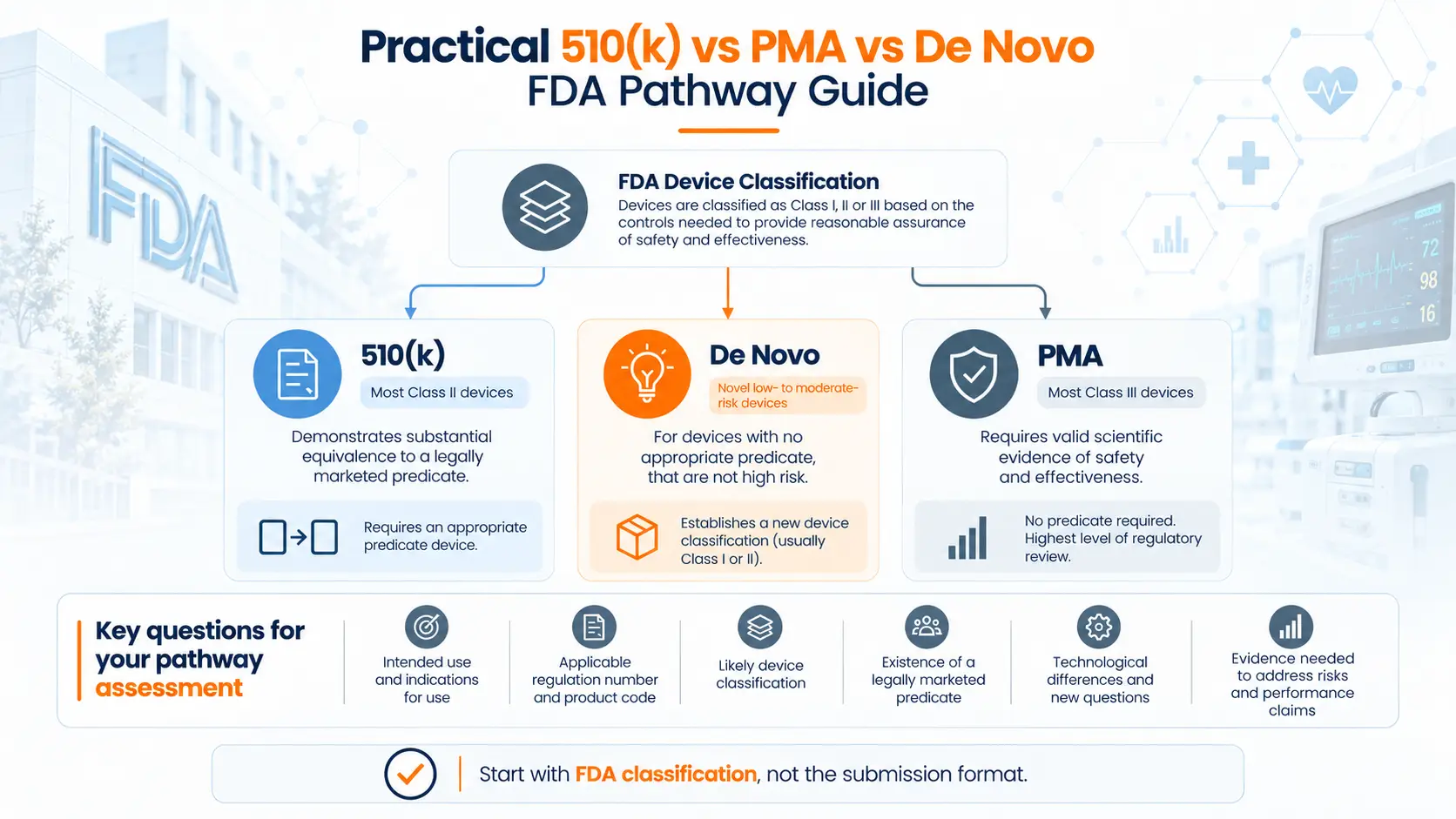
Start with FDA classification, not the submission format
The regulatory pathway follows the device’s classification and applicable regulatory controls. FDA classifies devices into Class I, II, or III based on the controls needed to provide reasonable assurance of safety and effectiveness. Its classification system contains approximately 1,700 generic device types, organized across 16 medical specialty panels. [4] For many Class II devices, a 510(k) is the applicable premarket route. Some Class I and Class II devices are exempt from premarket notification, while devices subject to PMA require an approved PMA before commercial distribution. [1][3][4]
A pathway assessment should establish:
- the proposed intended use and indications for use
- the applicable regulation number and product code, where one exists
- the likely device classification
- whether an appropriate legally marketed predicate exists
- whether technological differences raise different questions of safety and effectiveness
- the evidence needed to address the device’s risks and performance claims
These questions are interconnected. A change in intended use, technological characteristics, or risk profile can alter the pathway analysis.
When classification remains uncertain, a manufacturer can submit a Section 513(g) Request for Information to obtain FDA’s written views on the device’s likely classification and the regulatory requirements that may apply. A 513(g) response is informational: it is not a classification order, a substantial equivalence decision, or a marketing authorization, and FDA does not review safety, effectiveness, or substantial equivalence data as part of the request. [4][5]
The practical takeaway is to resolve classification questions before building a submission strategy around a pathway that may not fit the device.
510(k) depends on a defensible substantial equivalence case
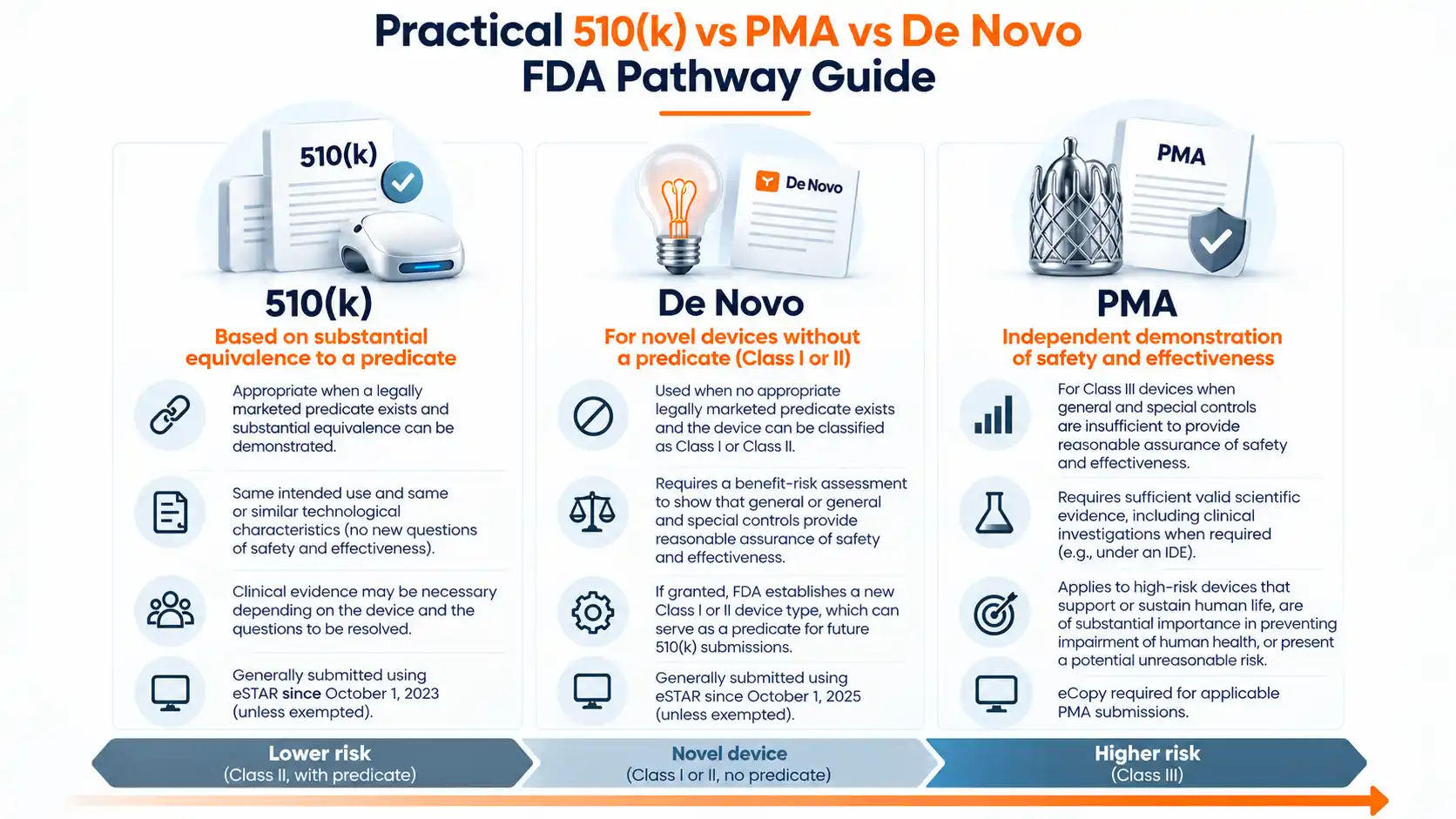
A 510(k) is appropriate when the device is subject to premarket notification and substantial equivalence can be demonstrated to a legally marketed predicate device. To be substantially equivalent, the new device must have the same intended use as the predicate and either the same technological characteristics or different technological characteristics that do not raise different questions of safety and effectiveness, with information demonstrating that the device is at least as safe and effective as the predicate. [1]
A predicate does not need to be identical to the new device. Intended use, design, materials, performance, safety, labeling, biocompatibility, applicable standards, and other relevant characteristics can form part of the substantial equivalence analysis. [1]
This is the key distinction in a 510(k) vs PMA comparison. A 510(k) depends on substantial equivalence to an eligible predicate, while PMA relies on an independent demonstration of reasonable assurance of safety and effectiveness.
A 510(k) should not automatically be treated as a nonclinical pathway. Clinical evidence may be necessary depending on the device and the questions that need to be resolved to support substantial equivalence.
Since October 1, 2023, 510(k) submissions must generally be submitted using FDA’s electronic Submission Template And Resource, or eSTAR, unless exempted from the electronic submission requirement. [1]
510(k) vs De Novo depends on predicate availability and risk
The central 510(k) vs De Novo distinction is whether an appropriate legally marketed predicate exists and whether the new device can appropriately be classified into Class I or Class II. The De Novo pathway applies to novel devices for which general controls alone, or general and special controls, can provide reasonable assurance of safety and effectiveness but for which there is no legally marketed predicate device. [2]
In a De Novo vs 510(k) decision, a manufacturer does not need to submit a 510(k) and first receive a Not Substantially Equivalent determination before pursuing De Novo. A direct De Novo request is permitted when the requester determines that no legally marketed device exists upon which to base a substantial equivalence determination. [2]
FDA still evaluates predicate availability during substantive review. If an appropriate legally marketed device of the same type can support a substantial equivalence determination, the proposed device does not fit the basis for De Novo classification. [2]
De Novo also requires a benefit-risk assessment. FDA evaluates whether applicable controls provide reasonable assurance of safety and effectiveness and whether the probable benefits of the device outweigh its probable risks. [2]
If FDA declines the request, the device remains in Class III and the requester may not legally market it under the De Novo request. Depending on the reasons for the decision, additional information or a different regulatory approach may be necessary. [2]
If FDA grants the request, FDA establishes a new Class I or Class II device type. The granted device may then serve as a predicate for future 510(k) submissions for devices of the same type, where applicable. [2]
Since October 1, 2025, De Novo requests must generally be submitted using eSTAR unless exempted. [2][6]
Consider a hypothetical connected diagnostic device using a novel technological approach with no appropriate predicate. If its probable benefits outweigh its probable risks and identified risks can be adequately addressed through general and special controls, De Novo may be the appropriate route. The absence of a predicate alone is not enough.
PMA requires an independent safety and effectiveness demonstration
PMA is FDA’s most stringent medical device marketing application and applies to devices subject to the Class III PMA framework. Class III applies when general and special controls are insufficient to provide reasonable assurance of safety and effectiveness and the device supports or sustains human life, is of substantial importance in preventing impairment of human health, or presents a potential unreasonable risk of illness or injury. [3]
In a PMA vs 510(k) comparison, PMA does not depend on establishing substantial equivalence to a predicate. FDA bases PMA approval on sufficient valid scientific evidence providing reasonable assurance that the device is safe and effective for its intended use. [3]
The De Novo vs PMA distinction therefore cannot be reduced to whether the technology is new. Novelty alone does not make De Novo appropriate. The relevant question is whether the device can appropriately be regulated as Class I or Class II with adequate controls or whether PMA requirements apply.
Clinical development also needs to be considered where clinical evidence is required. FDA’s PMA data requirements include clinical investigations, and any investigation conducted under an Investigational Device Exemption (IDE) must be identified as such in the PMA application. [3]
Consider a hypothetical implantable therapeutic device whose risks cannot be adequately addressed through Class I or Class II controls. If the device is subject to PMA, the evidence strategy needs to support the PMA standard, including the applicable clinical investigation requirements where clinical evidence is necessary.
510(k) vs PMA vs De Novo at a glance
A useful 510(k) vs PMA vs De Novo comparison starts with the regulatory question each pathway asks.
| Factor | 510(k) | De Novo | PMA |
|---|---|---|---|
| Typical regulatory setting | Most non-exempt Class II devices and certain other devices subject to 510(k) | Novel low-to-moderate risk device without an appropriate legally marketed predicate | Device subject to Class III PMA requirements |
| Predicate required | Yes | No. De Novo is available only when no appropriate legally marketed predicate exists | No |
| Core FDA question | Does the device have the same intended use as an eligible legally marketed predicate, and is it at least as safe and effective, without raising different questions of safety and effectiveness? | Can the new device type be classified into Class I or II because applicable controls adequately address its risks and probable benefits outweigh probable risks? | Does valid scientific evidence provide reasonable assurance of safety and effectiveness for the intended use? |
| Evidence strategy | Evidence supports substantial equivalence and addresses relevant technological differences | Evidence addresses benefits, risks, performance, and controls for the proposed new device type | Valid scientific evidence, generally including clinical data, provides reasonable assurance of safety and effectiveness |
| FDA outcome | 510(k) clearance following a substantial equivalence determination | De Novo grant and establishment of a new Class I or Class II device type | PMA approval |
| Future predicate effect | An eligible cleared device may serve as a predicate where appropriate | A granted De Novo device may serve as a predicate for future 510(k)s of the same type, where applicable | A device subject to PMA cannot serve as a 510(k) predicate. A device originally marketed through PMA and later downclassified to Class I or II may qualify |
| Current electronic format | eSTAR required unless exempted | eSTAR required unless exempted | eCopy is required for applicable PMA submissions; eSTAR is voluntary for original PMAs and panel-track, real-time, 180-day, and 30-day notice/135-day supplements. [7][8] |
The practical takeaway is that these FDA pathways are not interchangeable options selected primarily according to cost or preferred timing. Classification, intended use, predicate availability, technological characteristics, risk controls, and evidence requirements need to support the same regulatory rationale.
How Meditrial supports FDA regulatory pathway strategy
Pathway selection is most useful when it is resolved early enough to inform the evidence program rather than simply label the eventual submission. Meditrial’s Regulatory Affairs team is set up to support FDA regulatory roadmap development, including 513(g), 510(k), De Novo, IDE, PMA, and FDA interactions.
Depending on the device and stage of development, the work may include classification and product-code research, predicate assessment, evidence planning, FDA interaction strategy, and preparation of the applicable submission.
For a 510(k), this may involve assessing whether the proposed predicate and substantial equivalence rationale remain defensible once intended use and technological characteristics are compared in detail. For De Novo, the emphasis shifts toward classification, benefit-risk evidence, and controls for a new device type. For PMA, regulatory strategy needs to remain aligned with the scientific evidence package and, where applicable, clinical investigations conducted under an IDE.
Where significant questions would benefit from FDA feedback before the planned submission, the Q-Submission Program includes mechanisms for interactions related to 510(k), De Novo, PMA, and IDE submissions. FDA finalized updated Q-Submission guidance in May 2025. [9]
What to establish before locking the FDA pathway
A defensible pathway decision connects regulatory classification with the actual development program. Before committing substantial resources, teams should be able to explain why the proposed pathway applies and how the planned evidence addresses its regulatory standard.
For a predicate-based route, that means testing the comparison beyond superficial product similarity. For a novel low-to-moderate risk device, it means establishing why an appropriate predicate is unavailable and why the proposed controls adequately address the identified risks. For a device subject to PMA, it means developing evidence against the independent safety and effectiveness standard.
Making the pathway decision early in development is more likely to keep regulatory strategy, testing, clinical planning, labeling, and FDA interactions aligned as the program progresses.
If you are defining an FDA strategy for a new medical device, contact Meditrial to discuss the classification, evidence requirements, and submission approach that should be evaluated for your program.
Frequently Asked Questions
How long do 510(k), De Novo, and PMA reviews take?
Review times differ by pathway, and FDA’s review period is usually only one part of the overall development timeline. Testing, clinical evidence generation, submission readiness, requests for additional information, and interactions with FDA can all affect planning. For orientation, FDA’s MDUFA V performance goals are 90 FDA review days for 510(k)s, 150 FDA review days for De Novo requests, and 180 FDA review days for original PMAs that do not require advisory panel input. [10] These goals count FDA days only and exclude periods when a submission is on hold, so they do not represent the total time to market. Current submission-specific review information should therefore be checked directly on the applicable FDA pathway page when developing a regulatory timeline.
What documentation should be reviewed before choosing an FDA pathway?
The assessment should include the intended use, indications for use, device description, technological characteristics, risk documentation, applicable classification regulations, product codes, potential predicates, and available performance evidence. For a novel device, teams should also assess whether general and special controls could adequately address the identified risks or whether PMA requirements apply.
When should a manufacturer consider a 513(g) request?
A 513(g) request may be considered when the classification or applicable regulatory requirements for a device are unclear. FDA responds with its views on classification and the requirements that may apply. The response does not classify, clear, or approve the device, or bind a later premarket review, and a user fee applies. See FDA, Classify Your Medical Device.
Do 510(k)s, De Novo requests, and PMAs always require clinical data?
No. Clinical evidence requirements depend on the device, pathway, intended use, risks, technological characteristics, and regulatory questions that need to be addressed. Many 510(k)s and some De Novo requests rely on nonclinical evidence, although clinical data may be needed depending on the device and the questions raised. PMA applications, by contrast, are generally expected to include clinical data, and FDA’s PMA content requirements include the results of clinical investigations. See FDA, Premarket Approval.
What drives the cost and internal workload of an FDA device submission?
The evidence program is usually a more meaningful workload driver than the pathway name alone. Bench testing, clinical investigations, biocompatibility, software and cybersecurity documentation, manufacturing information, risk documentation, predicate work, and FDA interactions may all contribute. The combination depends on the device and the questions that need to be addressed.
Who ultimately determines the FDA classification and applicable pathway?
FDA makes regulatory determinations through the applicable processes, while the manufacturer develops and supports its proposed regulatory rationale. Teams can research existing classifications and predicates, consider a Section 513(g) request to obtain FDA’s views on classification, and use the Q-Submission Program for appropriate pre-submission interactions.
Sources
[1] FDA, Premarket Notification 510(k), accessed October 2, 2026
[2] FDA, De Novo Classification Request, accessed October 2, 2026
[3] FDA, Premarket Approval (PMA), accessed October 2, 2026
[4] FDA, Classify Your Medical Device, accessed October 2, 2026
[5] FDA, FDA and Industry Procedures for Section 513(g) Requests for Information under the Federal Food, Drug, and Cosmetic Act, Final Guidance, accessed October 2, 2026
[6] FDA, Electronic Submission Template for Medical Device De Novo Requests, Final Guidance, accessed October 2, 2026
[7] FDA, eCopy Medical Device Submissions, accessed October 2, 2026
[8] FDA, eSTAR Program, accessed October 2, 2026
[9] FDA, Requests for Feedback and Meetings for Medical Device Submissions: The Q-Submission Program, Final Guidance, May 2025, accessed October 2, 2026
[10] FDA, MDUFA Performance Goals and Procedures, Fiscal Years 2023 Through 2027 (MDUFA V commitment letter), accessed October 2, 2026
Table of Contents
Practical 510(k) vs PMA vs De Novo FDA Pathway Guide
Practical 510(k) vs PMA vs De Novo guidance for choosing an FDA device pathway based on classification, predicates, risk, and evidence needs
Build a Defensible Clinical Evidence Strategy Under EU MDR
Build a defensible clinical evidence strategy under MDR Annex XIV, from the clinical evaluation plan to PMCF and notified body review.
Getting a CE mark for medical devices: a step-by-step guide
Practical guidance on the CE mark for medical devices under EU MDR, from classification and evidence to conformity assessment and EUDAMED
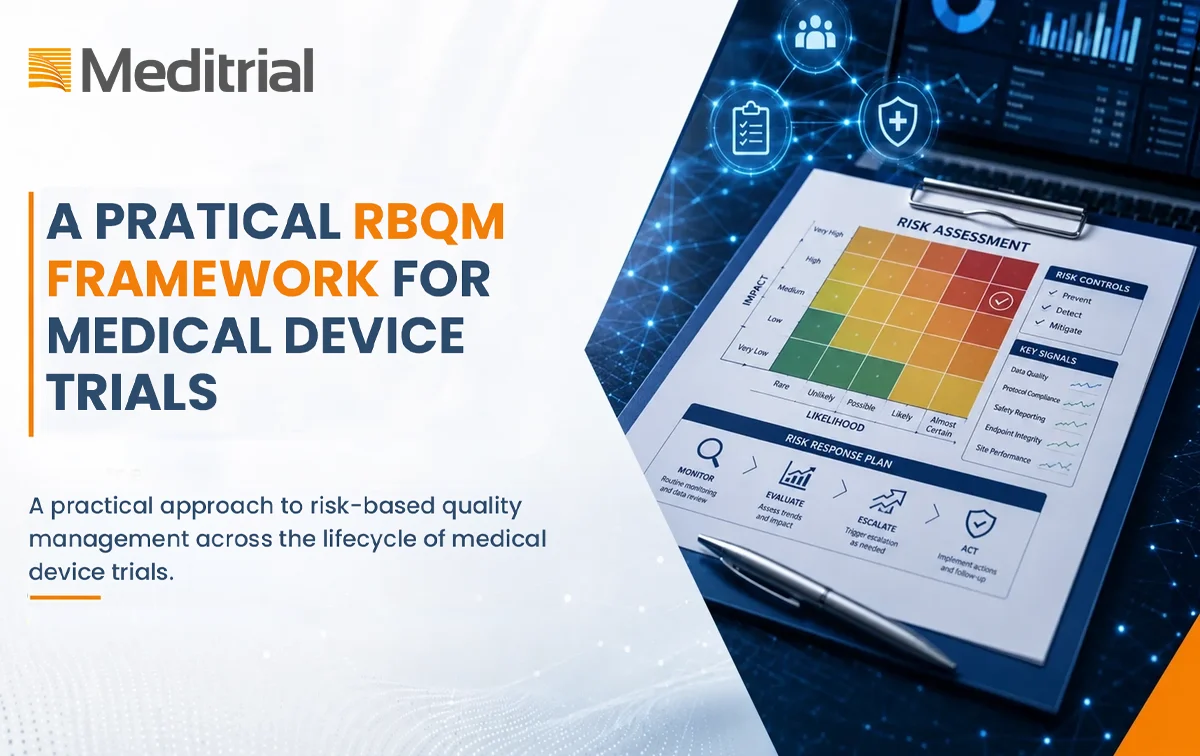
A Practical RBQM Framework for Medical Device Trials
Risk-based quality management for medical device trials, with practical actions for risk assessment, monitoring, data review, and trial oversight
EU Breakthrough Medical Devices Under MDCG 2025-9 (BtX)
EU breakthrough medical devices gain a clearer regulatory pathway under MDCG 2025-9, with early advice and lifecycle evidence planning
What Swissmedic Fast-Track Means for Clinical Trial Sponsors
Swissmedic swissethics Fast-Track Pilot Project accelerates eligible trial reviews and makes coordinated regulatory preparation increasingly important.
This article provides general information and does not constitute regulatory or legal advice. Requirements should be confirmed for the specific study, applicable regulatory framework, and markets concerned.