FDA Breakthrough Device Acceleration
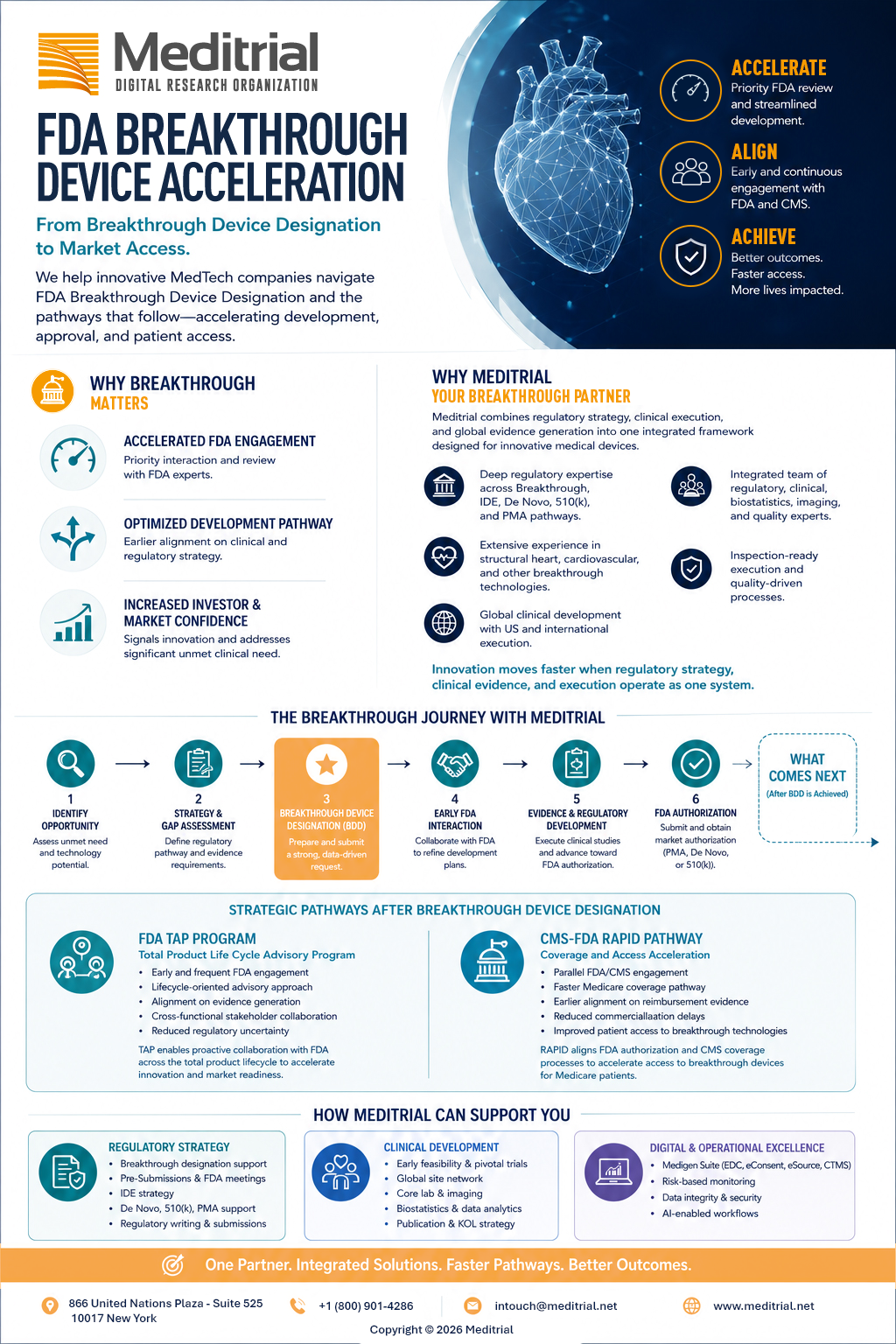
FDA Breakthrough Device Acceleration From Designation to Market Access
FDA Breakthrough Device Designation (BDD) is one of the most powerful regulatory tools available to MedTech innovators today. It grants priority FDA interaction, streamlined clinical pathway guidance, and a clear signal to investors and payers that your device addresses a significant unmet clinical need. In 2026, a new Medicare coverage pathway—RAPID—makes this designation more valuable than ever.
This article explains what Breakthrough Device Designation is, who qualifies, what comes after designation, and how Meditrial’s integrated regulatory and clinical expertise helps companies navigate every step from opportunity assessment to market authorization.
- 1,246 Breakthrough designations granted since 2015
- 185 Devices reached FDA market authorization
- ~160 Designations awarded in 2025
- 60–90 Days to Medicare coverage under RAPID
Sources: FDA CDRH (Dec 31, 2025); CMS/FDA RAPID announcement (Apr 23, 2026).
What Is FDA Breakthrough Device Designation?
FDA Breakthrough Device Designation is a voluntary program that accelerates the development and review of medical devices offering more effective treatment or diagnosis of life-threatening or irreversibly debilitating conditions. Designated companies receive priority FDA review, enhanced regulatory interaction, and flexible clinical study designs to speed patient access.
Established by Congress through the 21st Century Cures Act, the Breakthrough Devices Program has become the FDA’s most established expedited device pathway. To qualify, a device must treat or diagnose a serious condition and meet at least one of four criteria, such as representing a meaningful clinical advantage over existing alternatives or addressing a condition with no approved options.
Why FDA Breakthrough Device Acceleration Matters in 2026
The program continues at a steady pace. The FDA is on track to grant approximately 168 designations in fiscal year 2026—consistent with the 164–166 range seen in 2022 through 2025. The top therapeutic areas remain cardiovascular, neurology, and orthopedics, with cardiovascular consistently leading. That means competition for designation is real, and the quality of your submission matters.
Beyond speed, designation delivers three strategic advantages:
- Accelerated FDA engagement: Priority interaction and review with FDA experts shortens alignment timelines on clinical and regulatory strategy.
- Optimized development pathway: Earlier guidance on endpoints, study design, and evidence thresholds reduces costly late-stage pivots.
- Investor and market confidence: BDD signals innovation and addresses significant unmet clinical need—two messages that resonate with investors, hospital systems, and payers alike.
The Breakthrough Journey: A Step-by-Step Roadmap
Navigating from an unproven concept to FDA authorization requires a coordinated strategy. Here is the Meditrial framework for moving through the Breakthrough journey efficiently:
- 1
Identify the Opportunity
Assess the unmet clinical need and evaluate whether your device can meaningfully advance treatment or diagnosis of a life-threatening or irreversibly debilitating condition. Early evidence of clinical differentiation strengthens every step that follows. - 2
Strategy & Gap Assessment
Define the most viable regulatory pathway—PMA, De Novo, or 510(k)—and identify evidence gaps. A thorough gap assessment prevents surprises during FDA review and helps prioritize pre-clinical and clinical investments. - 3
Prepare and Submit the BDD Request
A strong, data-driven Breakthrough Device Designation request submitted via Q-Submission must clearly articulate clinical benefit, unmet need, and eligibility criteria. Incomplete or weakly argued submissions are the most common cause of denial. - 4
Early FDA Interaction
Once designated, engage FDA through Pre-Submission meetings and the TAP program to refine development plans, align on clinical endpoints, and resolve open regulatory questions before they become barriers. - 5
Evidence & Regulatory Development
Execute clinical studies—early feasibility, IDE pivotal trials, and global studies—while building the regulatory package. Aligning evidence generation with FDA and CMS requirements simultaneously is critical to avoiding the post-authorization coverage gap. - 6
FDA Authorization
Submit the final premarket application and obtain market authorization via PMA, De Novo, or 510(k). Designation does not guarantee authorization, but it substantially improves the predictability and speed of review.
What Comes After Breakthrough Designation?
Achieving BDD is not the finish line—it is the starting line for a structured, proactive regulatory strategy. Two critical programs define what happens next.
The FDA TAP Program (Total Product Life Cycle Advisory Program)
What TAP Does
TAP provides early and continuous FDA engagement across the full product lifecycle. It enables cross-functional collaboration, reduces regulatory uncertainty, and aligns evidence generation from early development through post-market—making it a natural complement to Breakthrough designation.
TAP’s lifecycle-oriented advisory approach helps companies anticipate regulatory expectations rather than react to them. For cardiovascular and other high-complexity breakthrough technologies, this proactive alignment can shave months off the development timeline.
The New CMS-FDA RAPID Pathway (Announced April 2026)
The single most significant driver of FDA breakthrough device acceleration in 2026 is the launch of the Regulatory Alignment for Predictable and Immediate Device (RAPID) coverage pathway, jointly announced by CMS and FDA on April 23, 2026.
Why RAPID Changes the Equation
Before RAPID, the gap between FDA authorization and Medicare national coverage—sometimes called the “valley of death”—routinely stretched beyond a year, leaving innovators with authorized devices and no reimbursement pathway. Under RAPID, CMS will issue a proposed national coverage determination on the same day a qualifying device receives FDA authorization, enabling Medicare coverage within 60 to 90 days of approval. Approximately 40 currently designated devices qualify for the pathway, with 20 more potentially eligible.
RAPID works by embedding CMS into the development process far earlier—during the investigational phase—so the evidence generated for FDA premarket review simultaneously supports Medicare coverage decisions. This parallel alignment eliminates the traditional sequential approach where companies only engaged CMS after FDA authorization.
| Factor | Without RAPID | With RAPID |
|---|---|---|
| Time to Medicare coverage | 12+ months post-authorization | 60–90 days post-authorization |
| CMS engagement timing | After FDA authorization | During clinical development |
| Evidence strategy | FDA-focused; CMS evidence separate | Unified FDA + CMS evidence plan |
| Commercialization delay | Significant; reimbursement uncertain | Substantially reduced |
| Patient access | Delayed by coverage uncertainty | Accelerated for Medicare patients |
Why Choose Meditrial as Your Breakthrough Partner?
Most regulatory consultancies and CROs operate in silos—strategy here, clinical operations there, data elsewhere. Meditrial was built differently. As a Digital Research Organization (DRO), Meditrial integrates regulatory strategy, clinical execution, and global evidence generation into a single, cohesive framework designed specifically for innovative medical devices.
That integration is what makes the difference at every inflection point of the Breakthrough journey:
- Deep regulatory expertise across Breakthrough Device Designation, IDE, De Novo, 510(k), and PMA pathways.
- Extensive cardiovascular and structural heart experience, the leading area for Breakthrough designations.
- Global clinical development with US and international site execution, enabling studies that satisfy both FDA and international regulatory bodies simultaneously.
- Integrated expert team spanning regulatory affairs, clinical operations, biostatistics, imaging, and quality assurance under one roof.
- Inspection-ready processes and a quality-driven culture built for the scrutiny breakthrough devices attract.
- AI-enabled digital infrastructure through the Medigen Suite—EDC, eConsent, eSource, and CTMS—powering risk-based monitoring, data integrity, and accelerated timelines.
Integration Is the Differentiator
Innovation moves faster when regulatory strategy, clinical evidence, and operational execution function as one integrated system—not three separate workstreams handed off sequentially.
Meditrial Services at a Glance
| Regulatory Strategy | Clinical Development | Digital & Operational |
|---|---|---|
|
|
|
Frequently Asked Questions
What is FDA Breakthrough Device Designation?
Breakthrough Device Designation is a voluntary FDA program that expedites development, assessment, and review of devices offering meaningful advances in treating life-threatening or irreversibly debilitating conditions. As of December 2025, the FDA had granted 1,246 designations since the program launched in 2015.
How many devices have received Breakthrough Device Designation so far?
As of December 31, 2025, the FDA granted 1,246 Breakthrough Device designations. Of those, 185 have gone on to receive FDA marketing authorization—a number that demonstrates both the program’s momentum and the real regulatory work required to reach market.
What are the benefits of Breakthrough Device Designation?
Key benefits include priority FDA review and interaction, earlier alignment on clinical and regulatory strategy, flexible study designs (including surrogate endpoints and smaller study populations where scientifically justified), and stronger positioning with investors and payers. Designation also enables access to the FDA TAP program and, in 2026, qualifies devices for the new RAPID Medicare coverage pathway.
What is the new RAPID pathway and how does it work?
The Regulatory Alignment for Predictable and Immediate Device (RAPID) pathway, announced jointly by CMS and FDA on April 23, 2026, aligns FDA premarket review and Medicare national coverage decisions so that qualifying breakthrough devices can receive Medicare coverage within 60 to 90 days of FDA authorization—compared to more than a year under the previous process. CMS engages with device manufacturers during clinical development rather than after authorization, allowing a unified evidence strategy.
What therapeutic areas have the most Breakthrough Device designations?
Cardiovascular, neurology, and orthopedics are consistently the top three. Cardiovascular remains the leading area overall, with Meditrial’s deep structural heart and cardiovascular experience making it a particularly strong partner for companies in that space.
How does Meditrial support the Breakthrough Device Designation process?
Meditrial provides end-to-end support: from initial opportunity assessment and BDD request preparation through early FDA interaction, clinical study design and execution, regulatory submissions, and post-authorization support. The integrated team—regulatory, clinical, biostatistics, imaging, and quality—operates under one framework designed to minimize handoffs and maximize development speed.
Getting a CE mark for medical devices: a step-by-step guide
Practical guidance on the CE mark for medical devices under EU MDR, from classification and evidence to conformity assessment and EUDAMED
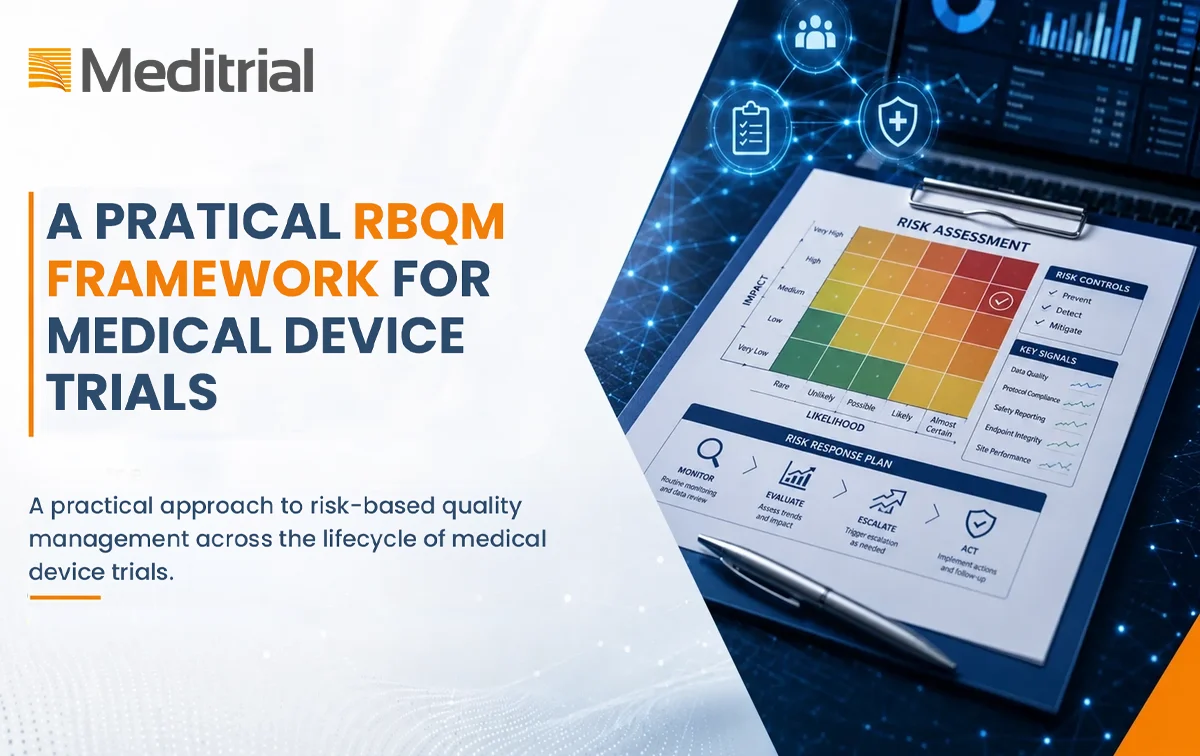
A Practical RBQM Framework for Medical Device Trials
Risk-based quality management for medical device trials, with practical actions for risk assessment, monitoring, data review, and trial oversight
EU Breakthrough Medical Devices Under MDCG 2025-9 (BtX)
EU breakthrough medical devices gain a clearer regulatory pathway under MDCG 2025-9, with early advice and lifecycle evidence planning
What Swissmedic Fast-Track Means for Clinical Trial Sponsors
Swissmedic swissethics Fast-Track Pilot Project accelerates eligible trial reviews and makes coordinated regulatory preparation increasingly important.
FDA Breakthrough Device Acceleration
How innovative MedTech companies can accelerate FDA approval, secure Medicare coverage, and reach patients faster—starting with Breakthrough Device Designation.

The contribution of patient associations in clinical trials
Historically, patient organizations have had the primary purpose of supporting the communities they represented. Today, this remains a crucial function, but modes have changed, as has the role that associations and patients themselves take on [...]
This article provides general information and does not constitute regulatory or legal advice. Requirements should be confirmed for the specific study, applicable regulatory framework, and markets concerned.