
Build a Defensible Clinical Evidence Strategy Under EU MDR

Under EU MDR, clinical evidence must be planned as a lifecycle system, not assembled at the end of development. A strong clinical evidence strategy connects intended purpose, clinical claims, risk management, clinical evaluation, investigations, and post-market evidence from the outset.
Article 61 of Regulation (EU) 2017/745 requires manufacturers to specify and justify the level of clinical evidence necessary to demonstrate conformity with applicable General Safety and Performance Requirements (GSPRs). Clinical evidence planning therefore needs to start early enough to shape how evidence is generated, appraised, and maintained.
Why clinical evidence strategy matters under EU MDR
A clinical evidence strategy defines what evidence is needed, where it will come from, and how it will support the device’s safety, performance, and clinical benefit. It should remain aligned with intended purpose, claims, risk management, clinical evaluation, and post-market activities throughout the lifecycle.
Clinical evaluation is a continuous process under MDR and must be updated with relevant post-market information, including post-market clinical follow-up (PMCF).
Consider a hypothetical Class IIb device manufacturer preparing a new indication. If the proposed claim is broader than the available clinical data support, the strategy should determine whether the claim should be narrowed, or whether further literature, data from the device or a demonstrably equivalent device, or a new clinical investigation is needed before making the claim. PMCF can address residual uncertainties once the device is on the market, but it does not replace sufficient pre-market clinical evidence to support the claim.
The practical takeaway is important: classification should not be treated as an administrative label added after product development. It determines, among other things, whether notified-body involvement is required (including for certain Class I devices, discussed below) and the depth of the applicable conformity assessment.
Consider a hypothetical manufacturer developing an active therapeutic device. A change to the intended purpose or operating principle can affect the applicable Annex VIII rule and potentially the risk class. Establishing these fundamentals early helps keep the regulatory strategy, clinical evidence plan, and technical documentation aligned.
What MDR Annex XIV requires for clinical evaluation planning
MDR Annex XIV Part A requires manufacturers to establish and keep updating a clinical evaluation plan. The plan identifies the GSPRs requiring clinical data and specifies the intended purpose, target groups, indications, contraindications, and intended clinical benefits with relevant outcome parameters.
It also sets out how clinical safety and residual risks will be examined, establishes parameters for benefit-risk acceptability against the state of the art, and includes a clinical development plan with milestones, acceptance criteria, and PMCF.
MDR Article 2(48) defines clinical data and its sources, including clinical investigations of the device, published studies and clinical experience relating to the device or an equivalent device, and clinically relevant post-market surveillance information.
Clinical investigations must follow MDR Articles 62 to 82 and Annex XV, as applicable; MDCG 2024-3 provides guidance on the content of the clinical investigation plan. [2] ISO 14155 is the good clinical practice standard for medical device investigations. ISO published a fourth edition (ISO 14155:2026) [3] in March 2026. However, EN ISO 14155:2020/A11:2024 [4] remains the version currently harmonized under the MDR, with harmonization of the 2026 edition pending.
Annex XIV Part A requires clinical data to be appraised for relevance and suitability. Where equivalence is used, technical, biological, and clinical characteristics must support the argument.
Equivalence has become more demanding under MDR. Manufacturers must have sufficient levels of access to data concerning the equivalent device under Annex XIV Part A and MDCG 2020-5 [5].
For implantable and Class III devices, exemption from conducting a clinical investigation based on equivalence to another manufacturer’s device under Article 61(4)-(5) also requires a contract providing full and ongoing access to that device’s technical documentation. MDCG 2023-7 [6] explains how sufficient levels of access can be demonstrated. Where such access is unavailable, manufacturers may need to rely more heavily on data generated for their own device.
The practical takeaway: confirm data access before building a strategy around equivalence.
How the CEP, CER, and PMCF work together
The Clinical Evaluation Plan (CEP) sets the methodology, while the Clinical Evaluation Report (CER) documents the resulting evaluation. They serve different functions within the same lifecycle process.
| Document | When | Purpose | MDR basis |
| Clinical Evaluation Plan (CEP) | Established and updated through the lifecycle | Defines clinical questions, data sources, appraisal methods, outcome parameters, and acceptance criteria | Annex XIV Part A, Section 1 |
| Clinical Evaluation Report (CER) | Prepared for conformity assessment and updated through the lifecycle | Documents appraisal and analysis of clinical data | Article 61; Annex XIV Part A |
| PMCF plan | Part of the post-market surveillance plan (Annex III) | Defines methods for collecting and evaluating clinical data after the device is placed on the market | Annex XIV Part B |
| PMCF evaluation report | Following PMCF activities | Documents findings and feeds conclusions into clinical evaluation and risk management | Annex XIV Part B, Section 7; Article 61(11) |
* Please note: This table alone should not be used to determine the applicable conformity assessment route for a specific product.
The minimum content required under Annex XIV, Part A, Section 1 covers the GSPRs requiring clinical data, the intended purpose, target groups, and intended clinical benefits with relevant outcome parameters, the approach to clinical safety and residual risk, the benefit-risk parameters, and the clinical development plan. The appraisal methodology, outcome parameters, and acceptance criteria set out below reflect common practice supported by MDCG guidance rather than verbatim requirements of Annex XIV.
A practical CEP should define:
- clinical questions arising from intended purpose, benefits, risks, and claims
- evidence sources, outcome parameters, and acceptance criteria
- methods for appraising relevance, quality, validity, and applicability
- evidence gaps requiring further clinical development or PMCF
- triggers for reassessment
A defensible CEP should also document the state-of-the-art analysis used to benchmark the device, a predefined systematic literature search and appraisal methodology, and clinical claims that are traceable to a defined clinical benefit under Article 2(53).
PMCF is part of the clinical evaluation lifecycle, not an activity reserved for high-risk devices. It applies unless the post-market surveillance plan justifies why PMCF is not applicable under Annex III. MDCG 2020-7 provides a template for the PMCF plan. [7]
For Class III and implantable devices, the PMCF evaluation report [8] and, where applicable, the Summary of Safety and Clinical Performance (SSCP) [9] must be updated at least annually under Article 61(11). Relevant Periodic Safety Update Report (PSUR) findings under Article 86 also contribute to the clinical evidence picture.
PMCF conclusions feed into clinical evaluation and risk management. Where findings result in relevant changes, the notified body may need to be informed under the applicable conformity assessment procedure.
What notified bodies review and where early dialogue fits
Notified bodies assess whether the clinical evaluation is appropriately planned, conducted, documented, and supported by sufficient clinical evidence. MDCG 2020-13 [10] establishes the minimum content of the Clinical Evaluation Assessment Report used to document that assessment.
Reading the CEP and CER against MDCG 2020-13 can help teams anticipate questions around evidence gaps, data relevance, appraisal methods, PMCF, risk management, and equivalence. For legacy devices, MDCG 2020-6 [11] provides additional guidance on sufficient clinical evidence.
Notified bodies cannot provide consultancy. [12] Pre-application structured dialogue may address procedural matters, such as classification and code identification, but does not extend to feedback on the acceptability of existing clinical data. Post-application structured dialogue may address the sufficiency of clinical data, the possible application of Article 61(10), equivalence, and the appropriateness of the PMCF plan, without compromising the notified body’s independence.
For Class III implantable devices and Class IIb active devices intended to administer or remove a medicinal product, the notified body must seek an expert-panel opinion on its clinical evaluation assessment report under Article 54 before certification, subject to the exceptions in Article 54(2). [13] Separately, for Class III devices and Class IIb active devices intended to administer or remove a medicinal product, the manufacturer may, prior to its clinical evaluation and/or investigation, request early scientific advice from an expert panel under Article 61(2) on the intended clinical development strategy and the proposed clinical investigations; the manufacturer must document how that advice was considered in the clinical evaluation report but may not invoke any rights arising from the panel’s views in the subsequent conformity assessment.
How Meditrial supports clinical evidence strategy
Developing a defensible clinical evidence strategy requires regulatory interpretation, clinical planning, and evidence appraisal to remain aligned. Meditrial’s Regulatory Affairs team supports these activities across the clinical evaluation lifecycle.
Depending on device classification, development stage, and available documentation, support may include:
- Evidence strategy development: mapping clinical questions and evidence requirements against MDR Article 61, Annex XIV, and applicable MDCG guidance
- CEP preparation: defining sources, appraisal methods, outcome parameters, acceptance criteria, evidence gaps, and PMCF integration
- Clinical investigation planning: supporting protocol development, endpoint selection, and study design
- Literature review and appraisal: applying a transparent, pre-defined method suited to the device and study types
- CER and PMCF support: structuring clinical data evaluation and planning post-market clinical evidence integration
Meditrial’s regulatory affairs services can be scoped around areas where additional regulatory or clinical expertise is needed.
Scope, timing, and what to plan next
The effort required to build or update the strategy depends on the device and the evidence already available. Key factors include classification, intended purpose, claims, existing investigations, literature, post-market experience, equivalence, and evidence gaps.
There is no universal timeline for CEP development. For legacy devices, MDCG 2020-6 explains how existing clinical and post-market data can support demonstration of sufficient clinical evidence under MDR.
Article 61(6)(a) can exempt certain implantable and Class III legacy devices from a new clinical investigation where the specified conditions are met and sufficient clinical data are available. Where meaningful gaps remain, additional clinical data may still be needed. Article 61(6)(b) provides a similar exemption from the obligation to perform a clinical investigation for well-established-technology implantable and Class III devices; the list of qualifying device types was expanded by Commission Delegated Regulation (EU) 2026/1451 [14], which entered into force on 19 July 2026. Clinical evaluation under Article 61 remains required in all cases.
The European Commission published a targeted proposal to amend the MDR and IVDR on 16 December 2025 (COM(2025) 1023) [15], including changes affecting Article 61. This article reflects the MDR requirements currently in force.
Planning the evidence strategy around MDR requirements, rather than treating the CER as an end-stage deliverable, reflects the lifecycle approach the MDR describes.
For support defining the evidence strategy, CEP, clinical investigation, CER, or PMCF scope for your device, submit an RFP to Meditrial.
Frequently Asked Questions
What is the difference between a Clinical Evaluation Plan and a Clinical Evaluation Report?
A Clinical Evaluation Plan defines how the clinical evaluation will be performed, while the Clinical Evaluation Report documents the evaluation and its conclusions. The CEP establishes the clinical questions, evidence sources, outcome parameters, appraisal methodology, and acceptance criteria. The CER records how relevant clinical data were appraised and analyzed against the device’s intended purpose, safety, performance, clinical benefits, and benefit-risk profile.
Does every medical device need a Clinical Evaluation Plan under EU MDR?
Yes, for devices subject to MDR conformity assessment; custom-made devices and in-house devices follow different provisions. MDR Annex XIV, Part A requires manufacturers to establish and update a Clinical Evaluation Plan as part of the clinical evaluation process. Where demonstrating conformity based on clinical data is not deemed appropriate, Article 61(10) does not remove the clinical evaluation requirement. Instead, it requires an adequate justification, based on risk management and the device’s interaction with the body, substantiated in the technical documentation and documented as part of the clinical evaluation.
Does PMCF apply only to Class III and other high-risk devices?
No. PMCF forms part of the clinical evaluation lifecycle unless the manufacturer justifies in the post-market surveillance plan why it is not applicable. The scale and methods should be proportionate to the device and remaining clinical uncertainties. Requirements are stricter for Class III and implantable devices.
How often should a Clinical Evaluation Plan be updated?
There is no single annual CEP update interval in MDR. The plan should be kept current as the device, intended purpose, claims, risks, state of the art, or clinical evidence changes. For Class III and implantable devices, the PMCF evaluation report and, where applicable, the SSCP must be updated at least annually, with relevant post-market findings feeding back into the clinical evaluation.
Can a manufacturer still use equivalence under EU MDR?
Yes, but the equivalence claim must satisfy MDR requirements for technical, biological, and clinical characteristics, and the manufacturer must have sufficient access to the relevant comparator data. Separately, to be exempt from performing a clinical investigation by relying on equivalence to another manufacturer’s device under Article 61(4)-(5), a contract providing full and ongoing access to that device’s technical documentation is also required.
What changes for a legacy device moving from the Directives to MDR?
The clinical evaluation must meet MDR requirements, but existing clinical and post-market data can remain relevant. MDCG 2020-6 explains the assessment of sufficient clinical evidence for legacy devices. Article 61(6)(a) also provides an exemption from new clinical investigations for certain implantable and Class III legacy devices where the regulatory conditions are met and sufficient clinical data support the device.
Regulatory position as of 22 September 2026.
References
[1] Regulation (EU) 2017/745 on medical devices (MDR). Articles 2, 61, 62–82 and 86; Annexes II, III, XIV and XV. EUR-Lex.
[2] MDCG 2024-3: Guidance on content of the Clinical Investigation Plan for clinical investigations of medical devices. Medical Device Coordination Group, March 2024.
[3] ISO 14155:2026: Clinical investigation of medical devices for human subjects — Good clinical practice (4th edition). International Organization for Standardization, March 2026.
[5] MDCG 2020-5: Clinical Evaluation – Equivalence. A guide for manufacturers and notified bodies. Medical Device Coordination Group, April 2020.
[6] MDCG 2023-7: Guidance on exemptions from the requirement to perform clinical investigations pursuant to Article 61(4)-(6) MDR and on sufficient levels of access to data needed to justify claims of equivalence. Medical Device Coordination Group, December 2023.
[7] MDCG 2020-7: Post-market clinical follow-up (PMCF) Plan Template. Medical Device Coordination Group, April 2020.
[8] MDCG 2020-8: Post-market clinical follow-up (PMCF) Evaluation Report Template. Medical Device Coordination Group, April 2020.
[9] MDCG 2019-9 rev.1: Summary of Safety and Clinical Performance. A guide for manufacturers and notified bodies. Medical Device Coordination Group.
[10] MDCG 2020-13: Clinical evaluation assessment report template. Medical Device Coordination Group, July 2020.
[11] MDCG 2020-6: Clinical evidence needed for medical devices previously CE marked under Directives 93/42/EEC or 90/385/EEC. A guide for manufacturers and notified bodies. Medical Device Coordination Group, April 2020.
[12] MDCG 2019-6 rev.5: Questions and answers: Requirements relating to notified bodies. Medical Device Coordination Group.
Table of Contents
Build a Defensible Clinical Evidence Strategy Under EU MDR
Practical guidance on the CE mark for medical devices under EU MDR, from classification and evidence to conformity assessment and EUDAMED

Getting a CE mark for medical devices: a step-by-step guide
Practical guidance on the CE mark for medical devices under EU MDR, from classification and evidence to conformity assessment and EUDAMED
A Practical RBQM Framework for Medical Device Trials
Risk-based quality management for medical device trials, with practical actions for risk assessment, monitoring, data review, and trial oversight

EU Breakthrough Medical Devices Under MDCG 2025-9 (BtX)
EU breakthrough medical devices gain a clearer regulatory pathway under MDCG 2025-9, with early advice and lifecycle evidence planning

What Swissmedic Fast-Track Means for Clinical Trial Sponsors
Swissmedic swissethics Fast-Track Pilot Project accelerates eligible trial reviews and makes coordinated regulatory preparation increasingly important.
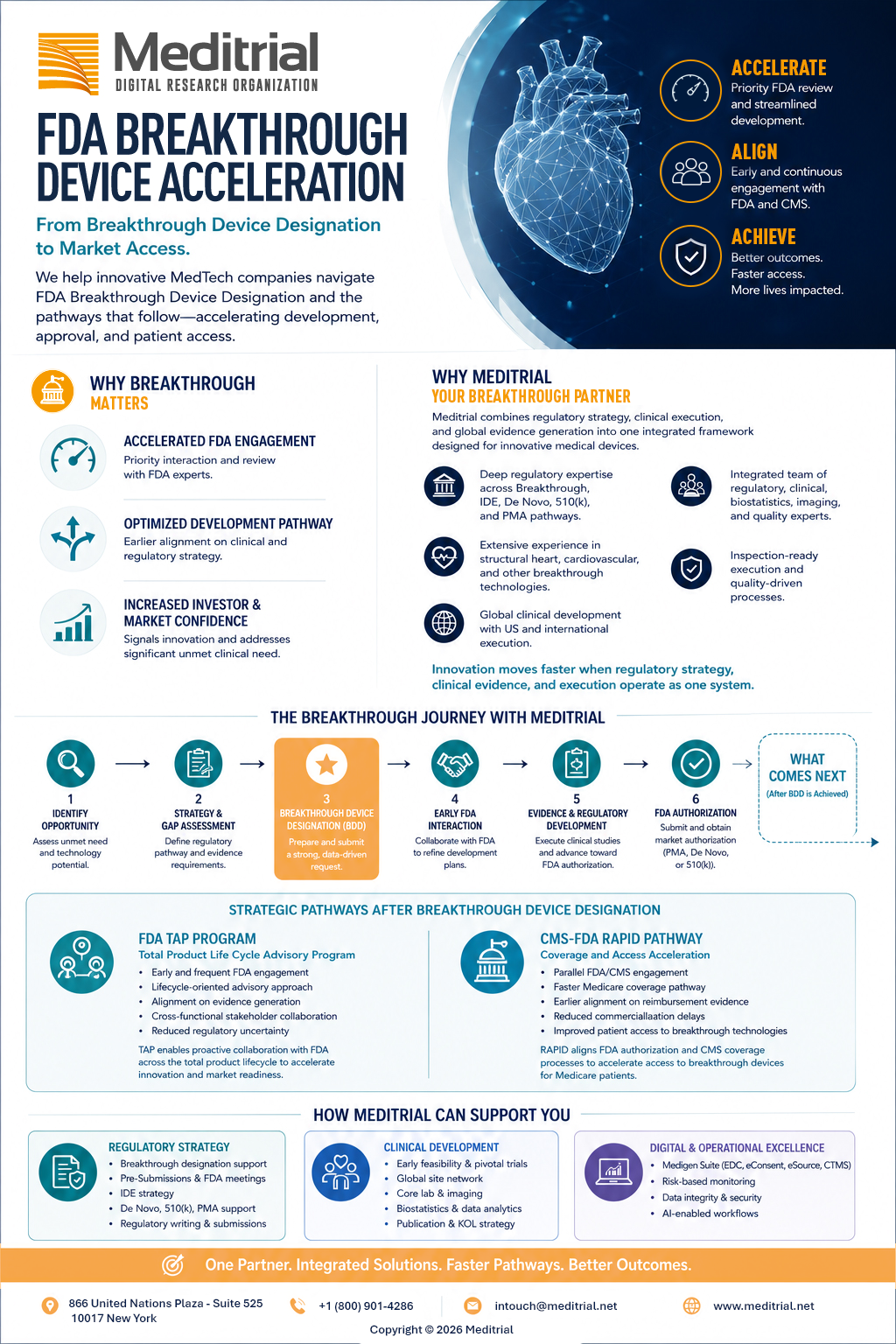
FDA Breakthrough Device Acceleration
How innovative MedTech companies can accelerate FDA approval, secure Medicare coverage, and reach patients faster—starting with Breakthrough Device Designation.
This article provides general information and does not constitute regulatory or legal advice. Requirements should be confirmed for the specific study, applicable regulatory framework, and markets concerned.