MDCG publishes new guidances on Equivalence, Legacy devices, PMCF and Ventilators
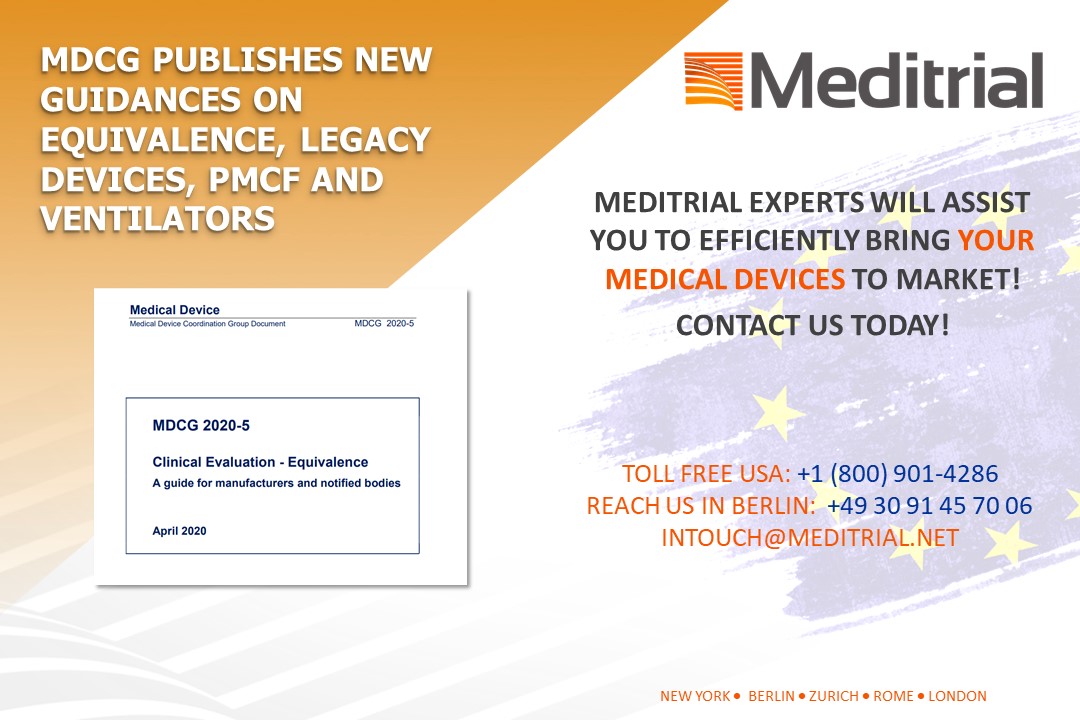
The European Commission’s Medical Device Coordination Group (MDCG) posted five new guidances on demonstrating equivalence to existing devices; clinical evidence for legacy devices; templates for post market clinical follow-up plans and evaluation reports; and regulatory requirements for ventilators.
Equivalence
The MDCG explains that while the MEDDEV 2.7/1 rev. 4 guidelines on clinical evaluation of medical devices under directives 93/42/EEC (MDD) and 90/385/EEC (AIMDD) should be referenced when demonstrating equivalence under MDR, the previous guidelines “are not fully aligned with the MDR.”
The aim of the new guidance is to explain the differences in technical, biological and clinical criteria for demonstrating equivalence.
MDCG 2020-5 Clinical Evaluation – Equivalence. A guide for manufacturers and notified bodies
Legacy devices
The aim of the new guidance on legacy devices is to explain how to generate sufficient clinical evidence to demonstrate conformity to the relevant general safety and performance requirements (GSPR) for legacy devices CE marked in accordance with the MDD and AIMDD.
The guidance provides specific recommendations for conducting clinical evaluations for legacy devices under Annex XIV Part A of the MDR.
Post market clinical follow-up (PMCF) templates
In two separate guidances, the MDCG provides templates for post market clinical follow-up plans and evaluation reports.
The guidances explain that the PMCF is “a continuous process that updates the clinical evaluation and that shall be addressed in the manufacturer’s post market surveillance plan.” The MDR also includes specific requirements for developing PMCF plans and evaluation reports.
Ventilators
In its guidance on ventilators and related accessories, the MDCG explains different regulatory options for a fast market entry of the much-needed devices amid the COVID-19 pandemic.
Additionally, the MDCG states: “In the exceptional COVID-19 context, the assessment procedures will ensure a short-term supply while guaranteeing patient safety. The Member State will evaluate the available technical documentation to find evidence that essential performance and safety requirements are guaranteed in the context of use.”
MDCG 2020-9 Regulatory Requirements for Ventilators and Related Accessories
Meditrial can help – Contact us for immediate support
Meditrial has developed rapid workflows to conduct risk assessment, implement rescue plans and execute solutions for ongoing clinical trials:
- Identify patients requiring follow-up
- Conduct investigator and study nurse calls for training to address the situation
- Obtain authorizations for decentralized data collection
- Support to patients for alternative access to needed care
- Prepare procedures and worksheets for remote collection of patient clinical data
- Monitor work instructions and trainings for site support and remote monitoring
- EDC and ePRO solutions to enable study continuity
- Privacy protection measures
Contact Meditrial for immediate assistance in Europe or the US.
Table of Contents
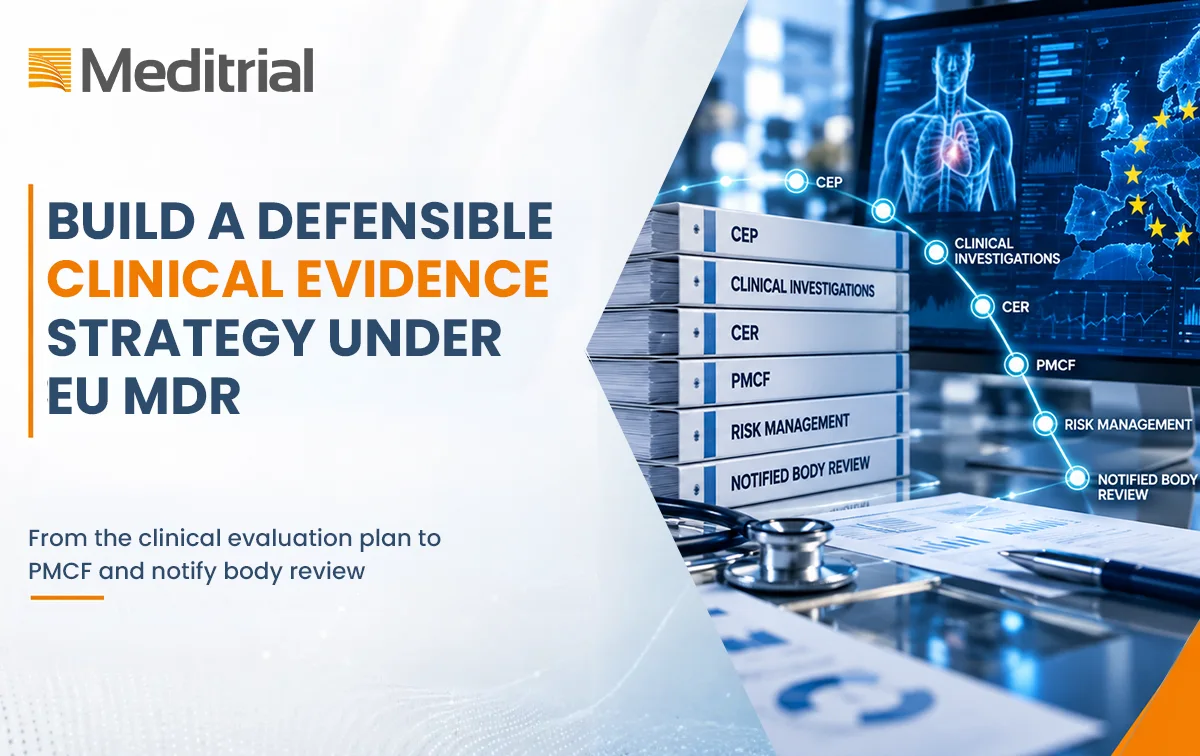
Build a Defensible Clinical Evidence Strategy Under EU MDR
Build a defensible clinical evidence strategy under MDR Annex XIV, from the clinical evaluation plan to PMCF and notified body review.
Getting a CE mark for medical devices: a step-by-step guide
Practical guidance on the CE mark for medical devices under EU MDR, from classification and evidence to conformity assessment and EUDAMED
A Practical RBQM Framework for Medical Device Trials
Risk-based quality management for medical device trials, with practical actions for risk assessment, monitoring, data review, and trial oversight
EU Breakthrough Medical Devices Under MDCG 2025-9 (BtX)
EU breakthrough medical devices gain a clearer regulatory pathway under MDCG 2025-9, with early advice and lifecycle evidence planning
What Swissmedic Fast-Track Means for Clinical Trial Sponsors
Swissmedic swissethics Fast-Track Pilot Project accelerates eligible trial reviews and makes coordinated regulatory preparation increasingly important.
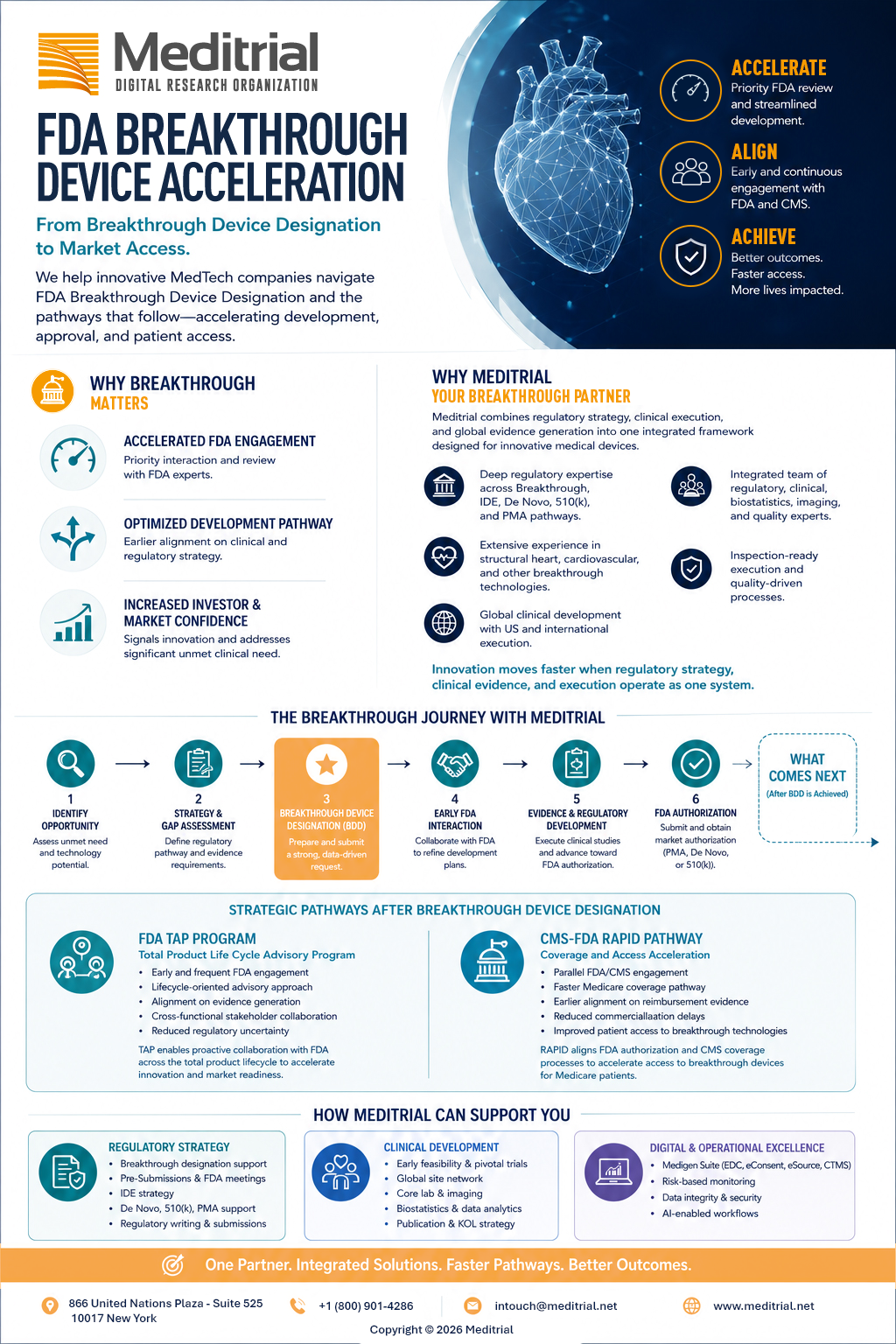
FDA Breakthrough Device Acceleration
How innovative MedTech companies can accelerate FDA approval, secure Medicare coverage, and reach patients faster—starting with Breakthrough Device Designation.
This article provides general information and does not constitute regulatory or legal advice. Requirements should be confirmed for the specific study, applicable regulatory framework, and markets concerned.