
Getting a CE mark for medical devices: a step-by-step guide
A CE mark for medical devices depends on a complete MDR conformity pathway, not a single application or certificate. Manufacturers need to establish the device’s intended purpose and classification, build the required quality and technical documentation, select the appropriate conformity assessment route, and complete the applicable registration steps before placing the device on the EU market.
Although “CE mark approval” is a common search phrase, it is not technically precise. There is no central EU authority that grants permission to use the CE mark. Under the MDR, the manufacturer remains responsible for demonstrating conformity and issuing the EU Declaration of Conformity, while a notified body must participate in the conformity assessment where the device’s classification and applicable procedure require it.
Step 1: Define the intended purpose and classify the device
A defensible CE marking process starts with the intended purpose because classification, evidence requirements, and the conformity assessment route all flow from it.
Under the MDR, devices are assigned to Class I, IIa, IIb, or III according to the classification rules in Annex VIII. Factors include duration of use, invasiveness, whether a device is active or implantable, the anatomical site involved, and the nature of the risks associated with its intended use. Qualification as a medical device under Article 2(1), including any relevant borderline assessment, should be established before the classification rules are applied.
The Medical Device Coordination Group’s MDCG 2021-24 rev.1, published in April 2026, provides current guidance for applying the MDR classification rules. MDCG guidance is not legally binding, but it reflects how Member State representatives interpret the rules and is used as a reference point by notified bodies and competent authorities. Rev.1 is mainly a clarification of the 2021 text. One change worth noting is that the discussion of implantable devices now refers to clinical rather than surgical procedures, which may affect devices introduced by non-surgical means.
The practical takeaway is important: classification should not be treated as an administrative label added after product development. It determines, among other things, whether notified-body involvement is required (including for certain Class I devices, discussed below) and the depth of the applicable conformity assessment.
Consider a hypothetical manufacturer developing an active therapeutic device. A change to the intended purpose or operating principle can affect the applicable Annex VIII rule and potentially the risk class. Establishing these fundamentals early helps keep the regulatory strategy, clinical evidence plan, and technical documentation aligned.
Step 2: Build the quality, risk, clinical, and technical documentation framework
CE marking for medical devices is supported by a connected set of quality and regulatory records rather than one standalone technical file.
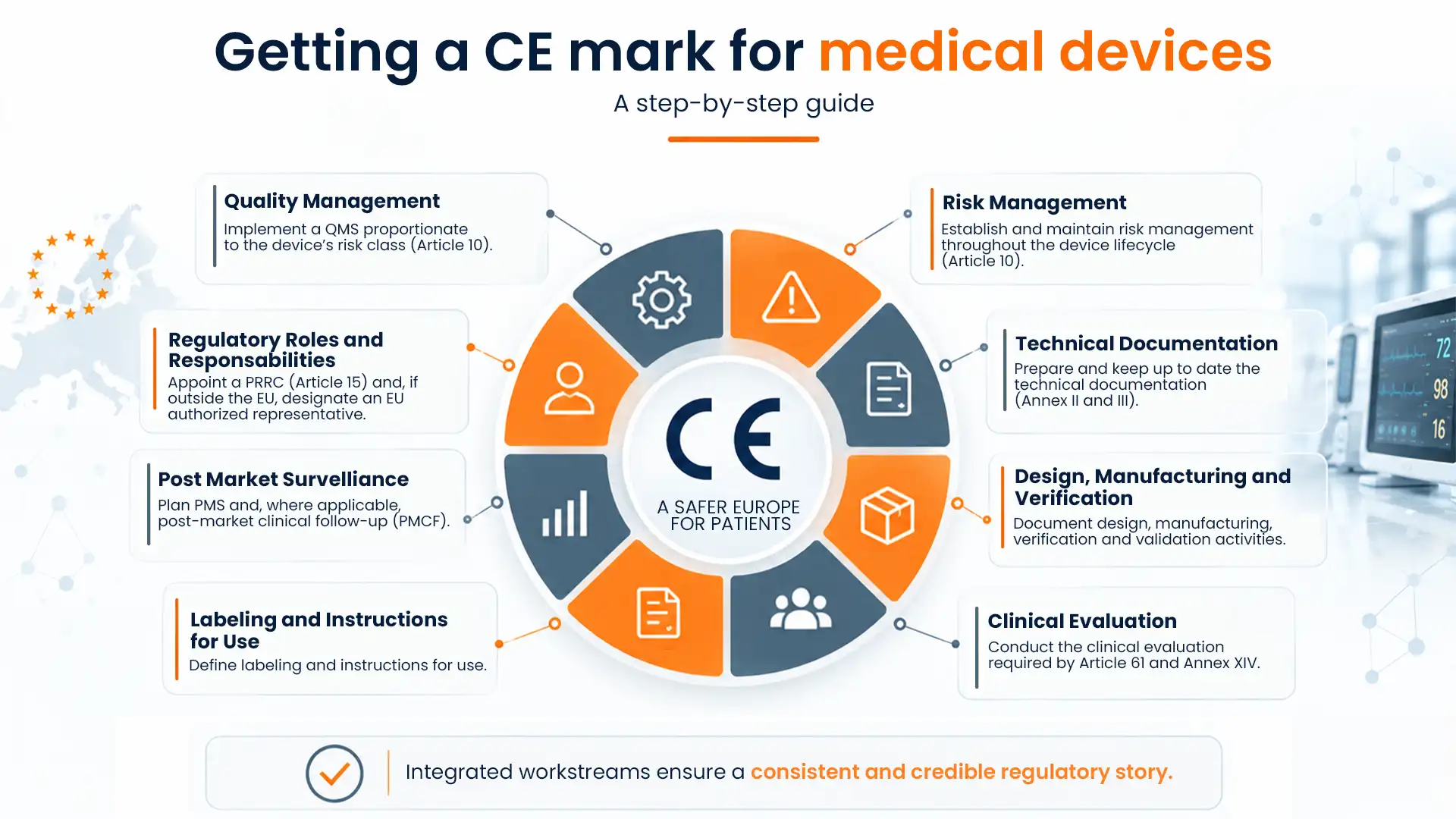
Article 10 of the MDR requires manufacturers to establish and maintain a risk management system, conduct a clinical evaluation, prepare and keep technical documentation up to date, and operate a quality management system proportionate to the risk class and type of device. The technical documentation requirements are principally set out in Annexes II and III.
Core workstreams typically include:
- demonstrating conformity with the General Safety and Performance Requirements in Annex I
- establishing and maintaining risk management throughout the device lifecycle
- preparing design, manufacturing, verification, and validation documentation
- defining labeling and instructions for use
- conducting the clinical evaluation required by Article 61 and Annex XIV
- planning post-market surveillance and, where applicable, post-market clinical follow-up
- implementing the MDR-required quality management system
- establishing the required regulatory roles and responsibilities
Under Article 15, manufacturers must have available within their organization at least one Person Responsible for Regulatory Compliance (PRRC) meeting the specified qualification requirements. Micro and small enterprises are not required to have the PRRC within the organization but must have that person permanently and continuously at their disposal. Manufacturers established outside the EU must designate a sole EU authorized representative before placing their devices on the Union market.
The practical advantage of treating these activities as connected workstreams is consistency. Intended purpose, risk controls, clinical claims, verification and validation, labeling, and post-market plans should tell the same regulatory story.
Step 3: Choose the correct conformity assessment route
The device class determines the basic level of third-party involvement, but the precise conformity assessment procedure must be selected under Article 52 and Annexes IX to XI.
A simplified view is*:
| Device category | Typical MDR conformity approach | Notified body involvement |
|---|---|---|
| Class I without special characteristics | Manufacturer prepares technical documentation and issues the EU Declaration of Conformity | Generally no |
| Class I sterile, measuring, or reusable surgical instrument | Manufacturer follows the applicable Article 52 procedure | Yes, limited to the relevant sterile, measuring, or reuse aspects |
| Class IIa | Applicable conformity assessment under Article 52, generally involving QMS and technical documentation assessment | Yes |
| Class IIb | Applicable conformity assessment under Article 52 with broader notified-body assessment | Yes |
| Class III | Highest MDR conformity assessment level, including notified-body assessment under the applicable route | Yes |
* Please note: This table alone should not be used to determine the applicable conformity assessment route for a specific product.
This table is intentionally simplified. Device-specific requirements and exceptions must be assessed against the relevant MDR provisions.
Borderline products, medical device and medicinal product combinations, Annex XVI products without an intended medical purpose, and devices with multiple functions may require additional qualification, classification, or conformity assessment considerations. The applicable route should be confirmed against Article 52, the relevant MDR annexes, and any applicable implementing acts or guidance, with the notified body where required.
For Class I devices that are neither sterile, measuring devices, nor reusable surgical instruments, the manufacturer generally declares conformity after preparing the required technical documentation. For Class Is, Im, and Ir devices, notified-body involvement is restricted to the aspects identified in Article 52(7).
For higher-risk classes, manufacturers must select a notified body designated for the MDR and for the relevant device scope. The European Commission publishes designated organizations through the NANDO system.
Engaging the notified body should therefore be planned as part of the regulatory strategy rather than treated as the final administrative step. The documentation, quality system, clinical evidence, and conformity assessment route need to be sufficiently mature for the applicable assessment.
Step 4: Complete conformity assessment, declaration, CE marking, UDI, and registration
Once conformity with the applicable MDR requirements has been demonstrated through the required procedure, the manufacturer completes the formal steps that support placing the device on the market.
Where a notified body is required, the manufacturer must first complete the applicable assessment and obtain the relevant certificate or certificates. The manufacturer then draws up the EU Declaration of Conformity under Article 19 and assumes responsibility for compliance with the MDR and other applicable Union legislation.
The CE marking is then affixed in accordance with Article 20 and Annex V. Where a notified body has participated in the conformity assessment as required under Article 52, its identification number accompanies the CE mark as applicable.
UDI and registration activities also need to be integrated into the sequence. The MDR requires assignment of the applicable Unique Device Identifier information and registration of device information. For certain notified-body assessed devices, the Basic UDI-DI is required before the conformity assessment application, so UDI planning should not be left until the end.
The EUDAMED position changed in 2026. Following Commission Decision (EU) 2025/2371, which confirmed that four EUDAMED electronic systems meet the applicable functional specifications, the Actor Registration, UDI/Device Registration, Notified Bodies and Certificates, and Market Surveillance modules became mandatory on May 28, 2026. New devices must be registered before being placed on the market. Devices already on the market before that date fall under a further transitional window for UDI/device registration, and manufacturers should confirm the current deadline against the Commission’s published timeline.
The remaining modules covering vigilance and post-market surveillance, and clinical investigations and performance studies, are being introduced separately under the gradual rollout framework in Regulation (EU) 2024/1860.
Step 5: Treat CE marking as the start of lifecycle compliance
Affixing the CE mark does not end the manufacturer’s MDR responsibilities.
Article 83 requires manufacturers to establish, document, implement, maintain, and update a post-market surveillance system appropriate to the device type and risk class. Information collected through that system feeds back into areas including risk management, labeling, clinical evaluation, and corrective actions.
Class I devices require a post-market surveillance report under Article 85. Class IIa, IIb, and III devices require a Periodic Safety Update Report under Article 86, with the applicable updating frequency depending on device class.
Clinical evaluation is likewise a lifecycle activity. The MDR requires clinical evaluation documentation to remain current, including through post-market clinical follow-up where applicable. Any change that could affect safety, performance, intended purpose, or the conformity assessment route requires a documented change assessment, and, depending on the change, notification to or prior approval by the notified body.
For regulatory teams, this changes the way the CE marking process should be scoped. An integrated regulatory architecture connects pre-market evidence, risk management, quality processes, post-market surveillance, and change management rather than treating certification as an isolated project.
How Meditrial supports the CE marking process
A CE marking program can involve regulatory strategy, classification, quality-system alignment, risk management, clinical evaluation, technical documentation, notified-body interaction, and registration activities running in parallel.
Meditrial’s Regulatory Affairs team supports EU CE marking and MDR compliance activities, including regulatory strategy, clinical evaluation, risk management, technical documentation, labeling, EUDAMED registration, and related regulatory workstreams.
For manufacturers with limited internal capacity or complex devices, coordinated regulatory support can help keep those workstreams aligned and make documentation more consistent with the applicable MDR requirements and conformity assessment strategy.
Teams preparing a new submission or reassessing an existing European strategy can review Meditrial’s Regulatory Affairs services to scope the support required for their device and development stage.
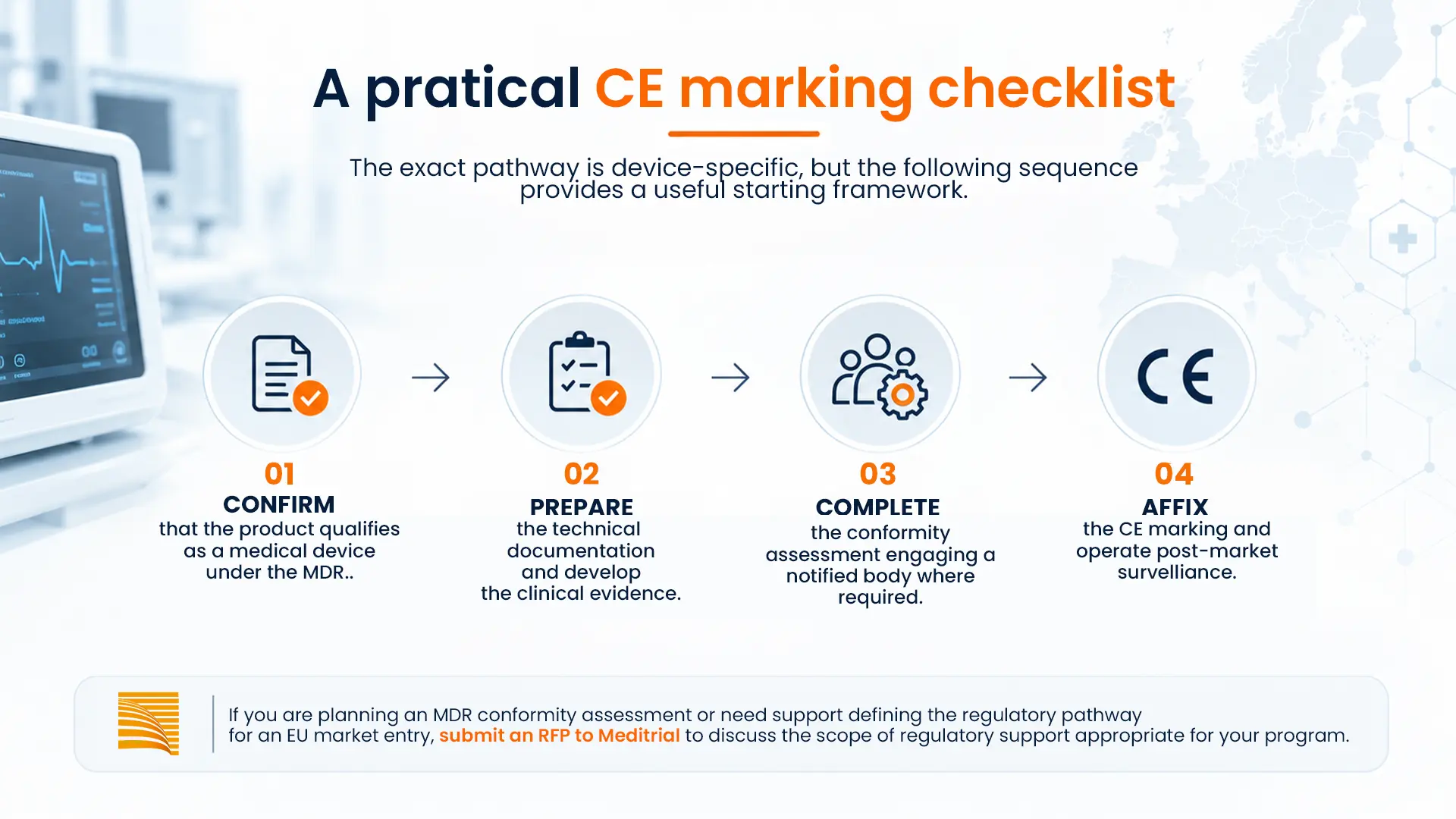
A practical CE marking checklist
The exact pathway is device-specific, but the following sequence provides a useful starting framework.
- Confirm that the product qualifies as a medical device under the MDR.
- Define and document the intended purpose.
- Apply the Annex VIII classification rules.
- Identify applicable General Safety and Performance Requirements.
- Establish the MDR-required quality and risk management processes.
- Develop the clinical evaluation and supporting clinical evidence.
- Prepare technical documentation under Annexes II and III.
- Select the Article 52 conformity assessment route.
- Engage an appropriately designated notified body where required.
- Complete conformity assessment and address applicable findings.
- Issue the EU Declaration of Conformity.
- Complete UDI and applicable EUDAMED registration requirements.
- Affix the CE marking in accordance with Article 20.
- Operate post-market surveillance, vigilance, PMCF, and regulatory maintenance processes as applicable.
For a hypothetical Class IIb manufacturer entering the EU for the first time, several of these activities may need to progress concurrently. Early alignment of classification, clinical evidence, quality-system readiness, technical documentation, and notified-body strategy can help reduce avoidable rework between those workstreams, without changing the assessment standards or decisions applied by the notified body.
If you are planning an MDR conformity assessment or need support defining the regulatory pathway for an EU market entry, submit an RFP to discuss the scope of regulatory support appropriate for your program.
Frequently Asked Questions
Is a CE mark for medical devices an EU approval?
No. A CE mark is not an approval granted by the European Commission or another central EU authority. The manufacturer demonstrates conformity with the applicable MDR requirements and issues the EU Declaration of Conformity. A notified body performs the required independent conformity assessment for devices and aspects for which the MDR requires third-party involvement.
Do all medical devices require a notified body for CE marking?
No. Most ordinary Class I devices can follow the manufacturer self-declaration route after the required technical documentation has been prepared. Class I sterile devices, devices with a measuring function, and reusable surgical instruments require limited notified-body involvement. Class IIa, IIb, and III devices require notified-body conformity assessment under the applicable MDR procedure.
What documents are required for CE marking a medical device?
The exact documentation depends on the device, but the MDR framework includes technical documentation under Annexes II and III, evidence addressing the General Safety and Performance Requirements, risk management documentation, clinical evaluation, labeling, post-market surveillance documentation, and the EU Declaration of Conformity. Additional documentation applies according to device characteristics, classification, and conformity assessment route.
How long does the medical device CE marking process take?
There is no single MDR timeline that applies to every device. The overall program depends on factors including classification, device complexity, maturity of the quality system and technical documentation, clinical evidence needs, testing requirements, notified-body availability, and questions arising during conformity assessment. Timelines should therefore be built from the device-specific evidence and assessment plan rather than a generic estimate.
What happens after a medical device receives its CE mark?
The manufacturer continues to have MDR obligations throughout the device lifecycle. These include maintaining the quality management system and technical documentation, conducting post-market surveillance, updating the clinical evaluation, operating applicable PMCF activities, meeting vigilance requirements, and preparing post-market surveillance or periodic safety update reports according to the device class.
Sources
- Regulation (EU) 2017/745 on medical devices, current consolidated text
- MDCG 2021-24 rev.1, Guidance on classification of medical devices, April 2026
- European Commission, Notified bodies for medical devices, including MDR designation and NANDO
- Commission Decision (EU) 2025/2371 of 26 November 2025 on the functionality of certain EUDAMED electronic systems
- European Commission, The EUDAMED first four modules will be mandatory to use as from 28 May 2026
- European Commission, EUDAMED Overview
- Regulation (EU) 2024/1860 of 13 June 2024, amending the MDR and IVDR as regards the gradual roll-out of EUDAMED
- European Commission, CE marking
Table of Contents
Getting a CE mark for medical devices: a step-by-step guide
Practical guidance on the CE mark for medical devices under EU MDR, from classification and evidence to conformity assessment and EUDAMED
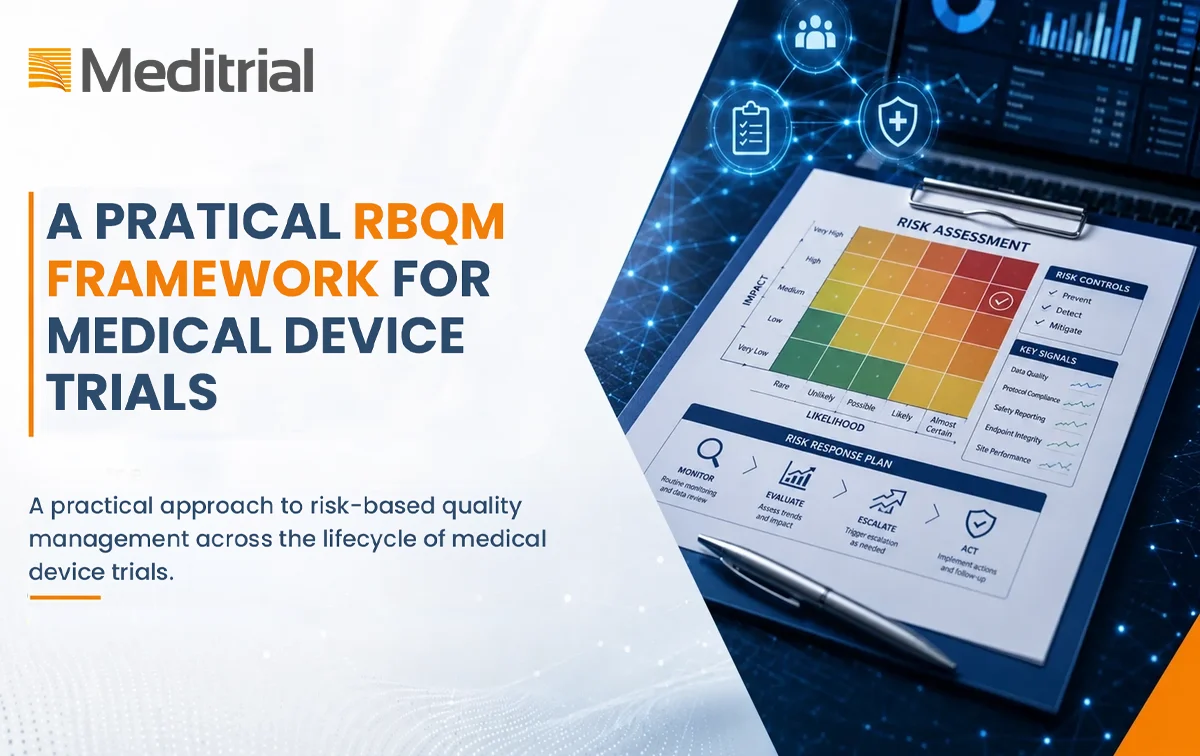
A Practical RBQM Framework for Medical Device Trials
Risk-based quality management for medical device trials, with practical actions for risk assessment, monitoring, data review, and trial oversight
EU Breakthrough Medical Devices Under MDCG 2025-9 (BtX)
EU breakthrough medical devices gain a clearer regulatory pathway under MDCG 2025-9, with early advice and lifecycle evidence planning

What Swissmedic Fast-Track Means for Clinical Trial Sponsors
Swissmedic swissethics Fast-Track Pilot Project accelerates eligible trial reviews and makes coordinated regulatory preparation increasingly important.
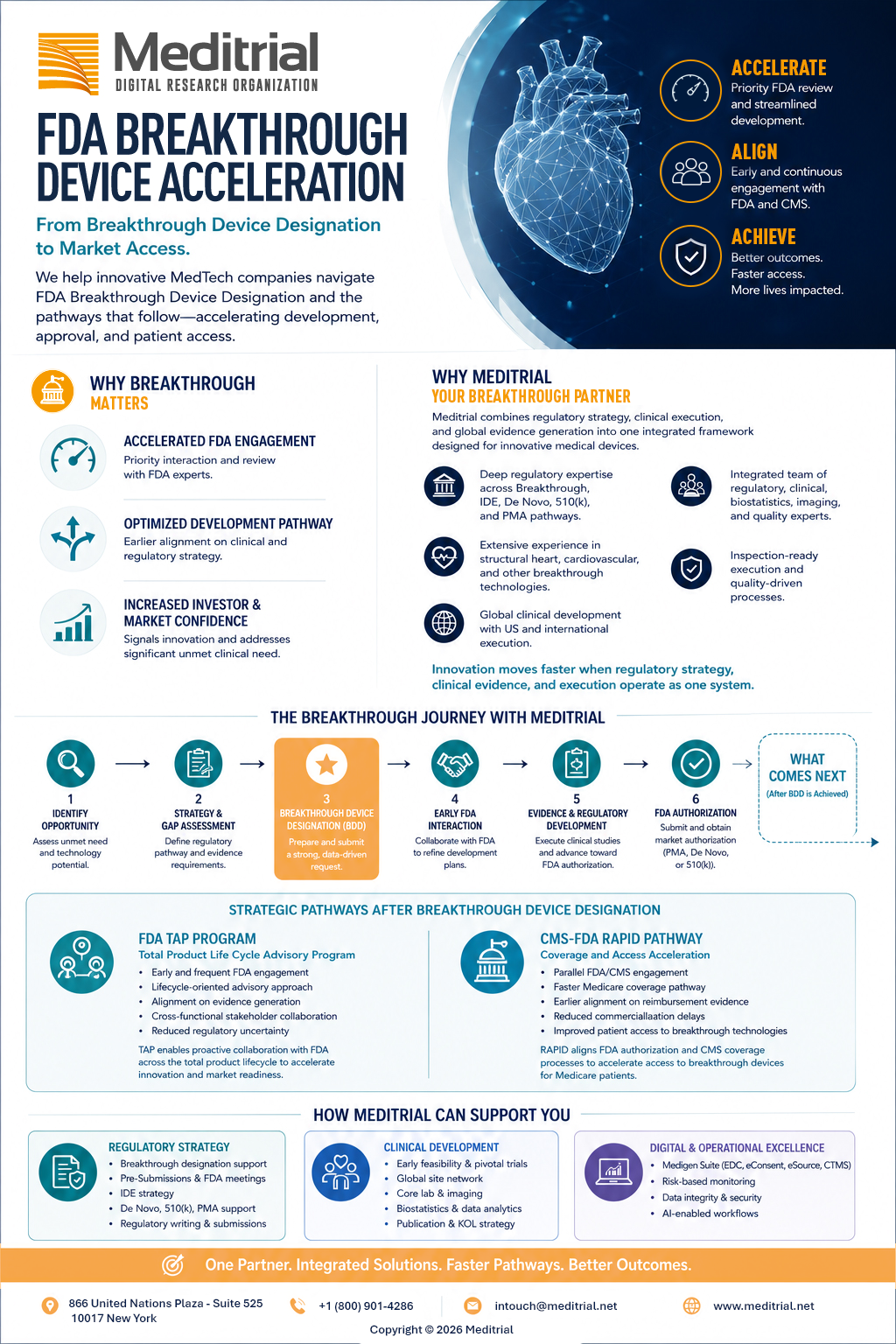
FDA Breakthrough Device Acceleration
How innovative MedTech companies can accelerate FDA approval, secure Medicare coverage, and reach patients faster—starting with Breakthrough Device Designation.

The contribution of patient associations in clinical trials
Historically, patient organizations have had the primary purpose of supporting the communities they represented. Today, this remains a crucial function, but modes have changed, as has the role that associations and patients themselves take on [...]
This article provides general information and does not constitute regulatory or legal advice. Requirements should be confirmed for the specific study, applicable regulatory framework, and markets concerned.