
Registering a medical device with the Medicines and Healthcare products Regulatory Agency (MHRA) is necessary for Great Britain market access, but registration alone does not establish regulatory compliance. Manufacturers must also address conformity assessment, clinical evidence, representation, and post-market obligations before and after placing a device on the market.
For manufacturers planning a UK launch, the strategy must account for different requirements in Great Britain and Northern Ireland, alongside evolving legislation and transitional arrangements for CE-marked devices. If the UK is one of several target markets, a global regulatory strategy for medical device launches helps decide where it fits in the sequence.
What the MHRA Requires Beyond Device Registration
The UK medical device regulatory framework establishes requirements throughout a device’s lifecycle. In Great Britain, medical devices are primarily regulated under the Medical Devices Regulations 2002 (SI 2002 No. 618, as amended), commonly called the UK MDR 2002. [1]
The UK MHRA is the government agency that regulates medicines and medical devices. The UK MDR 2002 applies to general medical devices, active implantable medical devices, and in vitro diagnostic medical devices (IVDs). Manufacturers must establish the applicable regulatory route, demonstrate conformity, and maintain appropriate technical and clinical documentation.
Registration does not constitute certification, approval, or endorsement by the regulator. It confirms that the required device information has been registered, rather than replacing conformity assessment. [2]
Assess Device Classification and Clinical Evidence
Device classification determines the applicable conformity assessment requirements and influences the clinical evidence needed for market access. Under the UK MDR 2002, general medical devices are classified as Class I, IIa, IIb, or III according to factors such as intended purpose, invasiveness, and duration of use.
Manufacturers of certain non-sterile, non-measuring Class I devices may self-declare conformity under the UKCA route. For UKCA marking, higher-risk devices, and Class I devices that are sterile or have a measuring function, require conformity assessment by a UK approved body. [1]
CE-marked devices, by contrast, follow the applicable EU conformity assessment route, involving an EU notified body where required. Our step-by-step guide to getting a CE mark for medical devices covers that route in more detail.
A practical evidence assessment addresses:
- Device description, intended purpose, and classification.
- Design, manufacturing, and risk management documentation.
- Applicable essential requirements and conformity evidence.
- Clinical evaluation and supporting clinical data.
- Labeling, instructions for use, and declarations of conformity.
Where available clinical evidence is insufficient, additional clinical investigation activities may be necessary.
Investigations conducted only in Great Britain must satisfy the UK MDR 2002, although applicants may demonstrate conformity with the EU MDR instead. Where an investigation includes Northern Ireland sites, the application must follow EU MDR requirements, and a single MHRA application can cover sites in both jurisdictions. [5]
Consider a hypothetical manufacturer developing an implantable cardiovascular device. Its regulatory plan must assess classification, clinical evidence, conformity assessment, and the potential need for further investigation data. Addressing these points early can support more realistic planning.
Choose Between UKCA and CE Marking
Great Britain accepts UKCA-marked devices and qualifying CE-marked devices under transitional arrangements, while Northern Ireland follows the applicable EU framework. [1][3]
| Regulatory consideration | Great Britain | Northern Ireland |
|---|---|---|
| Regulatory framework | UK MDR 2002, as amended | EU MDR 2017/745 and EU IVDR 2017/746 |
| Accepted conformity marking | UK approved body for relevant UKCA assessments; EU notified body for relevant CE assessments | CE marking, with UK(NI) where applicable |
| Conformity assessment | UK approved body for relevant UKCA assessments; EU notified body for relevant CE assessments | EU notified body, or UK notified body with CE and UK(NI) marking where applicable |
| Registration | Registration before market placement | EUDAMED for non-custom-made devices; MHRA for custom-made devices |
| Representation | UK Responsible Person for non-UK manufacturers | EU or Northern Ireland Authorized Representative where required |
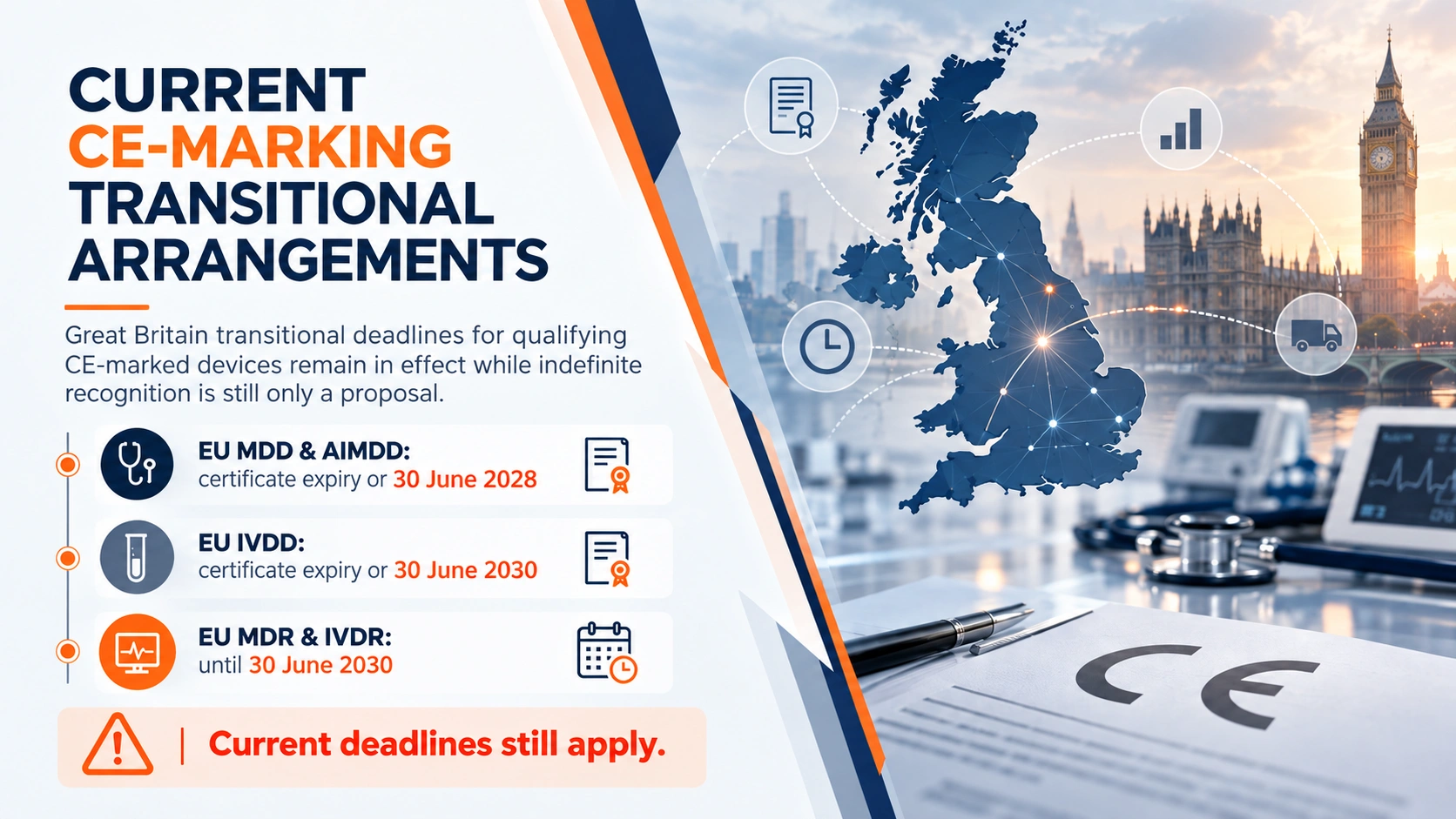
Current CE-marking transitional arrangements
Qualifying devices may continue to be placed on the Great Britain market under these arrangements:
- EU MDD and AIMDD devices: Until the earlier of the applicable certificate expiry or June 30, 2028.
- EU IVDD devices: Until the earlier of the applicable certificate expiry or June 30, 2030.
- EU MDR and EU IVDR devices: Until June 30, 2030.
Eligibility conditions and exceptions apply, including provisions for certain certificates considered valid under EU transitional extensions. [1]
On February 16, 2026, the regulator launched a consultation on potentially extending recognition of qualifying CE-marked devices indefinitely. It closed on April 10, 2026. [6]
Indefinite recognition remains a proposal. Until the government responds and any change is made in law, the current transitional deadlines apply.
Manufacturers should assess whether existing CE documentation supports their Great Britain launch or whether UKCA marking is appropriate.
Complete MHRA Registration and UK Representation
All medical devices placed on the Great Britain market must be registered with the regulator, including qualifying CE-marked devices. This includes IVDs, custom-made devices, and systems or procedure packs. [2]
Manufacturers established outside the UK must appoint a single UK Responsible Person (UKRP) for their devices placed on the Great Britain market. The appointment requires a letter of designation, a legal contract identifying the exclusive UK Responsible Person and the mandatory tasks undertaken on behalf of the manufacturer. Meditrial offers UK Responsible Person services for manufacturers without a UK presence.
Labeling requirements depend on the conformity marking. Where a UKCA mark is affixed, the UK Responsible Person’s name and address must appear on the product labeling, outer packaging, or instructions for use, as applicable. They are not required on the labeling of CE-only devices. [1]
Registration is completed through DORS using relevant manufacturer and device information, including Global Medical Device Nomenclature (GMDN) categories. A device is not considered registered until confirmation has been received. [2]
Registration fees from April 2026
A revised annual registration fee structure took effect on April 1, 2026. For the April 2026 to March 2027 period, the fee is £300 per year per Level 2 GMDN category, or per Level 1 category where no Level 2 exists.
Multiple devices within the same applicable category do not each incur a separate category fee. Registrations made during the charging period are charged pro rata, and the rate is subject to annual revision. [2]
Maintain Post-Market Surveillance and Vigilance
Regulatory responsibilities continue after a medical device enters the Great Britain market. The Medical Devices (Post-market Surveillance Requirements) (Amendment) (Great Britain) Regulations 2024 introduced strengthened post-market surveillance (PMS) requirements applicable to devices placed on the market or put into service in Great Britain from June 16, 2025. [4]
These requirements apply to devices within scope, whether UKCA-marked or CE-marked. Manufacturers must establish a PMS system supported by a documented plan for collecting and evaluating safety, performance, complaints, and other relevant feedback.
The framework also establishes serious incident reporting timelines and requirements for trend analysis, preventive and corrective actions, and periodic PMS reporting.
Risk management must remain connected to post-market evidence. ISO 14971, Medical devices – Application of risk management to medical devices, provides a recognized framework for identifying, evaluating, and controlling device-related risks. [4]
Consider a hypothetical manufacturer distributing an orthopedic implant in both Great Britain and the EU. Shared surveillance data may support both markets, but reporting procedures and competent authority obligations must be assessed separately.
How Meditrial Supports UK Market Access
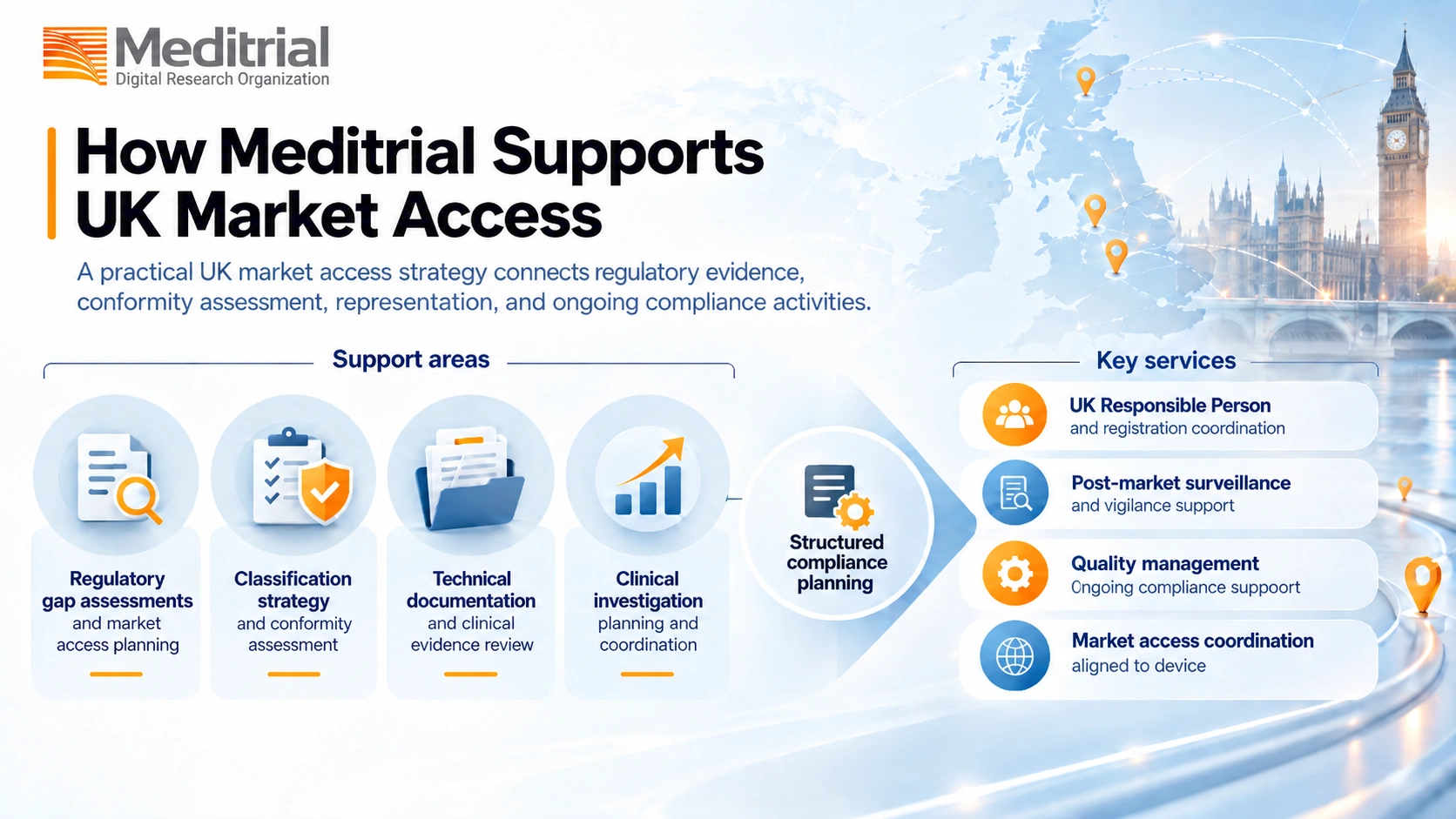
A practical UK market access strategy connects regulatory evidence, conformity assessment, representation, and ongoing compliance activities. Meditrial supports medical device manufacturers through regulatory affairs, clinical research, quality assurance, and in-country representation services.
Depending on the device and regulatory pathway, support may include:
- Regulatory gap assessments and market access planning.
- Classification and conformity assessment strategy.
- Technical documentation and clinical evidence review.
- Clinical investigation planning and coordination.
- UK Responsible Person services and registration coordination.
- Post-market surveillance, vigilance, and quality management support.
Through its market access and commercial solutions services, Meditrial can assist manufacturers in coordinating regulatory activities around their device characteristics, existing documentation, and target markets.
This approach is designed to support structured compliance planning without treating registration as the final regulatory milestone.
Plan Around Upcoming UK Regulatory Reforms
On May 8, 2026, the regulator published the draft Medical Devices (Amendment) Regulations 2026 through the World Trade Organization notification process. [6]
The draft proposes an international reliance pathway for devices authorized by regulators in Australia, Canada, or the United States, alongside compulsory unique device identification (UDI), revised IVD classification requirements, and strengthened technical documentation provisions.
These are draft provisions and do not apply until the final regulations are made and in force.
An initial market access assessment should therefore establish the device’s classification, conformity marking eligibility, clinical evidence gaps, representation requirements, and post-market obligations under current law, while considering potential future changes.
To discuss your device, available documentation, and intended market access pathway, submit an RFP to Meditrial.
Frequently Asked Questions
What is the MHRA, and what does MHRA stand for?
MHRA stands for the Medicines and Healthcare products Regulatory Agency, the UK government agency that regulates medicines and medical devices. For medical devices, the UK MHRA handles registration, market surveillance, vigilance, and clinical investigation notifications, and designates UK approved bodies. In Great Britain it applies the UK Medical Devices Regulations 2002. In Northern Ireland it acts as the competent authority under the EU MDR and IVDR.
How much does MHRA medical device registration cost?
MHRA medical device registration is charged through an annual fee based on GMDN registration categories, rather than individual devices. From April 1, 2026, the fee is £300 annually per Level 2 GMDN category, or Level 1 where no Level 2 exists, for the April 2026 to March 2027 period. Registrations made during the period are charged pro rata, and the rate is subject to annual revision.
Do CE-marked medical devices still need UK registration?
Yes. Qualifying CE-marked medical devices placed on the Great Britain market must be registered with the MHRA, even when they are accepted under existing transitional arrangements. Manufacturers must also meet applicable representation, labeling, and post-market obligations. In Northern Ireland, non-custom-made devices fall under EUDAMED registration requirements, while custom-made devices remain subject to MHRA registration.
What is a UK Responsible Person for medical devices?
A UK Responsible Person is an entity established in the UK that performs specified regulatory tasks on behalf of a manufacturer established outside the UK. These responsibilities include registering devices with the regulator and cooperating with the authority. The appointment must be documented through a letter of designation specifying the relationship and mandatory tasks. The manufacturer retains its regulatory responsibilities under the applicable framework.
How long does MHRA medical device registration take?
Registration timing varies, and a device counts as registered only once the MHRA confirms its registration. Processing depends on account arrangements, the completeness of submitted information, and whether additional documentation is requested. Manufacturers must distinguish registration from any separate conformity assessment or clinical investigation review, which has its own requirements and timelines.
Is UKCA marking mandatory for every medical device in the UK?
No. Qualifying CE-marked medical devices may continue to enter the Great Britain market under applicable transitional arrangements, while UKCA marking remains a domestic conformity assessment route. Northern Ireland follows the applicable EU medical device framework and requires CE marking, with UK(NI) marking where applicable. The correct route depends on device classification, conformity documentation, and the intended market.
Sources
[1] MHRA, Regulating medical devices in the UK. Published December 31, 2020; updated February 20, 2026.
[2] MHRA, Register medical devices to place on the market. Published December 31, 2020; updated July 20, 2026.
[3] MHRA, Regulation of medical devices in Northern Ireland. Updated June 11, 2026.
[4] MHRA, Requirements of the manufacturer’s PMS system. Updated September 5, 2025.
[5] MHRA, Clinical investigations in Great Britain. Published March 31, 2026; updated July 23, 2026.
[6] MHRA regulatory reform publications:
- Medical devices regulations: targeted consultation on the indefinite recognition of CE marked devices. Published February 16, 2026.
- MHRA invites views on proposed changes to medical device regulation. Published May 11, 2026.
Table of Contents
Latest Articles
A Confident UK Device Launch Starts With Your MHRA Strategy
Registering a medical device with the Medicines and Healthcare [...]

A Clearer Global Regulatory Strategy for Medical Device Launches
The order in which a device enters its markets [...]
Practical 510(k) vs PMA vs De Novo FDA Pathway Guide
Practical 510(k) vs PMA vs De Novo guidance for choosing an FDA device pathway based on classification, predicates, risk, and evidence needs
This article provides general information and does not constitute regulatory, legal, clinical, or compliance advice. Requirements and appropriate processes may vary by study, product, jurisdiction, and organization. Medigen Suite functionality should be used in accordance with applicable regulations, study documentation, and internal procedures.