
The order in which a device enters its markets can shape cost and timeline as much as its classification does. A global regulatory strategy medical device manufacturers agree on before the first filing is where that order gets decided, along with which evidence can be reused across regulators.
Most teams plan one market at a time, usually after the first authorization comes through. That works until the second or third market, which inherits a file built for somebody else’s reviewer.
Why market sequencing is a regulatory decision
Whichever market you file in first sets the template for everything after it. That first dossier fixes how the technical documentation is organized, how the clinical program is designed and how far the quality system reaches.
Commercial priorities usually set the order, and the regulatory gaps surface later. A US 510(k) built on substantial equivalence may not carry the clinical evidence the EU Medical Device Regulation (MDR) expects [1]. Choosing between a 510(k), PMA or De Novo pathway therefore shapes what the EU file will need later. A clinical investigation run outside the US has to meet specific conditions before FDA will accept its data [2].
The practical answer is to decide the launch order and the evidence plan together, before the first protocol is locked.
What a global regulatory strategy for medical devices has to settle
A country-level plan asks the same questions of every target market, then looks for the answers that overlap. For each jurisdiction, it should pin down:
- the device’s risk class under local rules, which can differ for the same product
- the route to market, such as 510(k), De Novo or PMA in the US, or a conformity assessment route under MDR Annexes IX to XI
- whether existing clinical data is enough, or whether a new investigation is needed and to which standard
- the quality system requirements and audit model that apply
- the representative, agent or license holder the jurisdiction requires
- the vigilance, post-market surveillance (PMS) and periodic reporting duties that begin at launch
Classification is usually the first place markets diverge. MDR Annex VIII sets out 22 classification rules, while FDA classifies by device type through the regulations in 21 CFR Parts 862 to 892 [1][3]. A device can be Class II in the US and Class III under MDR, and where data will be shared, the medical device regulatory strategy has to be built to the stricter requirement.
Where jurisdictions align, and where they diverge
There is more common ground than there used to be, though less than the word “harmonization” suggests. ISO 13485:2016 is the reference quality management system (QMS) standard across most major markets. Since 2 February 2026, FDA’s Quality Management System Regulation (QMSR) has incorporated it by reference into 21 CFR Part 820 [4].
The Medical Device Single Audit Program (MDSAP) covers the QMS requirements of Australia, Brazil, Canada, Japan and the US in one audit [5]. Health Canada requires an MDSAP certificate for Class II to IV device licenses [6], and FDA accepts MDSAP audit reports in place of routine inspections [5]. The International Medical Device Regulators Forum (IMDRF) has also published a common table of contents for regulatory submissions [7].
Clinical evidence is where the frameworks split most clearly. MDR Article 61 and Annex XIV require a clinical evaluation based on sufficient clinical data, and equivalence claims face tighter conditions than under the old directives [1]. Building a defensible clinical evidence strategy under EU MDR early makes that gap easier to plan around. A 510(k) asks whether the device is substantially equivalent to a legally marketed predicate, which is a different test.
Several moving deadlines also belong in the plan:
- For legacy devices certified under the former directives, Regulation (EU) 2023/607 extended the MDR transitional period to 31 December 2027 or 31 December 2028, depending on device class and subject to conditions [8].
- Great Britain accepts CE-marked devices until 30 June 2028 at the latest if they were certified under the former medical device directives, and until 30 June 2030 if they are certified under the MDR or the In Vitro Diagnostic Medical Devices Regulation (IVDR) [9]. The Medicines and Healthcare products Regulatory Agency (MHRA) consulted in early 2026 on recognizing those devices indefinitely and had not published an outcome as of October 2026 [10].
- The EU Health Technology Assessment Regulation (EU) 2021/2282 has applied since 12 January 2025, with joint clinical assessments for selected high-risk devices starting in 2026 [11].
- The European Commission proposed targeted revisions to the MDR and IVDR in December 2025, and the proposal is still going through the legislative process [12].
Shared audits and file structures can cut duplicated work, but clinical evidence and local presence still need a market-by-market answer in any global regulatory strategy for medical devices.
Comparing requirements across major markets
The table below shows the core framework and local presence requirement in each market, along with what can be shared.
| Market | Authority | Core framework | Local presence for foreign manufacturers | Shared or reliance elements |
| United States | FDA (CDRH) | FD&C Act; 21 CFR Parts 807, 812, 814, 820 | US Agent (21 CFR 807.40) [13] | MDSAP reports accepted in place of routine inspections [5]; non-US clinical data under 21 CFR 812.28 [2] |
| European Union | Notified bodies and national competent authorities | MDR (EU) 2017/745; IVDR (EU) 2017/746 | EU Authorized Representative (MDR Article 11) [1] | Harmonized standards support presumption of conformity |
| Great Britain | MHRA | UK MDR 2002, as amended | UK Responsible Person | CE-marked devices accepted until 30 June 2028 or 30 June 2030, depending on certification [9] |
| Switzerland | Swissmedic | Medical Devices Ordinance (MedDO) | Swiss Authorized Representative | Recognition of EU notified body certificates [14] |
| Canada | Health Canada | Medical Devices Regulations (SOR/98-282) | No in-country representative required; importers and distributors hold an establishment license | MDSAP certificate required for Class II to IV [6] |
| Australia | TGA | Therapeutic Goods Act 1989 | Australian sponsor | Can draw on evidence from comparable overseas regulators |
| Japan | MHLW / PMDA | PMD Act | Designated Marketing Authorization Holder | MDSAP participant |
| Brazil | ANVISA | RDC 751/2022, as amended | Brazilian Registration Holder | MDSAP participant |
| China | NMPA | State Council Order No. 739, as amended | Legal agent in China | Local testing and registration requirements apply |
The last column shows what carries over. An MDSAP-ready quality system and a well-structured technical file travel well, while local representation has to be arranged market by market.
A regulatory strategy example: sequencing a Class IIb launch
Take a hypothetical mid-size manufacturer whose non-implantable device is Class IIb under MDR and Class II in the US, with a workable predicate. One reasonable sequence:
- File the US 510(k) first. This could support earlier US entry if the predicate comparison holds, and FDA’s review goal for a 510(k) is 90 FDA days [15].
- Start the EU clinical evaluation under Annex XIV at the same time, because notified body capacity and MDR evidence expectations both take lead time.
- Design any new clinical investigation to ISO 14155 and to the conditions in 21 CFR 812.28, so one dataset has a realistic chance of supporting both submissions [2]. The current edition is ISO 14155:2026, which replaced the 2020 edition in March 2026 [16]. In October 2026, the 2020 edition was still the one harmonized under MDR and recognized by FDA [17].
- Use a single MDSAP audit to inform the Canada, Australia, Japan and Brazil filings.
- Appoint the UK Responsible Person and Swiss representative well before either market is on the calendar.
Once the team has decided which evidence gets built once and reused, the order of markets mostly follows.
How Meditrial supports market access and regulatory affairs for global launches
Meditrial is set up to support a global regulatory strategy medical device manufacturers can run as a single program across target markets. On the regulatory side, that covers FDA pathway selection and submissions and EU MDR and IVDR conformity, including clinical evaluation reports. It also covers international registrations in Canada, Latin America, Australia, New Zealand, Israel, Japan, China and Korea.
Local presence is often what holds a launch up, so Meditrial also acts as US Agent, EU Authorized Representative, UK Responsible Person and Swiss Representative. Through its market access and commercial solutions services, Meditrial also connects regulatory planning to reimbursement and coverage strategy. Authorization says a device can be sold, but it says nothing about whether anyone will pay for it.
The work is structured to produce a sequenced roadmap tied to the evidence plan and technical documentation built for reuse. Where the market list justifies it, it also includes a quality system scoped with MDSAP in mind. Depending on device classification and the state of existing documentation, this approach can help reduce rework as later markets are added, while authorization decisions stay with each authority and notified body.
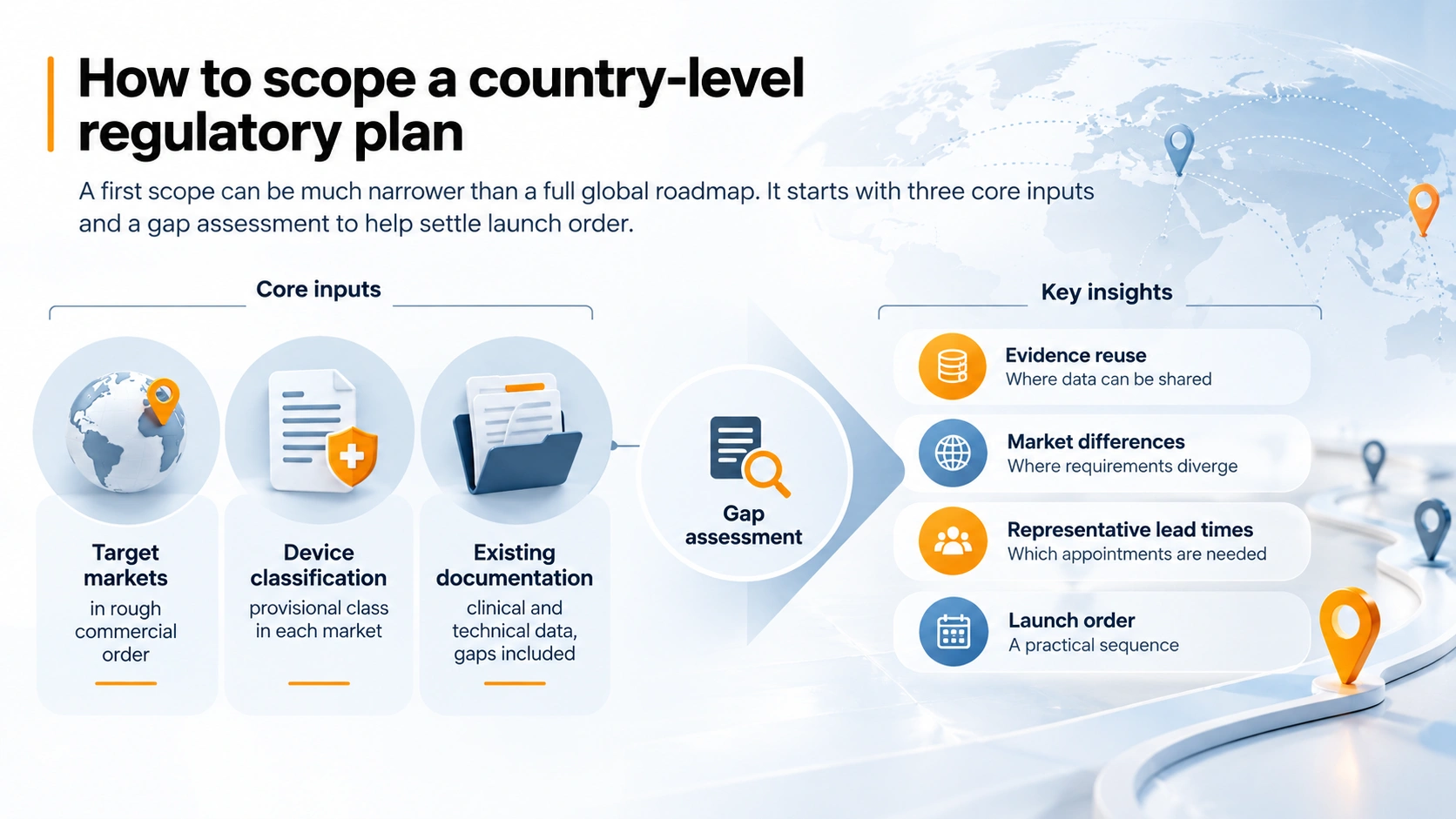
How to scope a country-level regulatory plan
A first scope can be much narrower than a full global roadmap. It needs three inputs:
- the target markets in rough commercial order
- the device’s provisional class in each market
- an inventory of the clinical and technical documentation you already have, gaps included
A gap assessment built on those inputs shows where evidence can be shared and where markets diverge. It also shows which representative appointments need lead time. That is usually enough to settle the launch order.
If you are planning a multi-market launch and want to scope the regulatory and market access work, submit an RFP or contact Meditrial’s team to talk through your device, your target markets and your timeline.
Frequently Asked Questions
What does a global regulatory strategy medical device companies use actually cover?
It is a plan for the order, pathway and evidence behind each market a device will enter. For every jurisdiction it settles classification, route to market, clinical evidence, quality system requirements and local representation. A good plan reuses documentation and data wherever a regulator allows it, so each new submission builds on the last.
Which market should a medical device manufacturer enter first?
There is no universal first market. The answer depends on how the device is classified in each jurisdiction, whether a US predicate exists, what clinical evidence is already available and where the commercial priorities sit. Many manufacturers look at the US and the EU first, because the evidence built for those two can inform later filings elsewhere.
Can one clinical investigation support both FDA and EU MDR submissions?
Yes, if it is designed for both from the start. Under 21 CFR 812.28, FDA accepts data from investigations conducted outside the US when they follow good clinical practice, including independent ethics review. Building the investigation to ISO 14155, currently the 2026 edition, and to the MDR’s clinical evidence expectations at the same time makes it more likely that one dataset can serve both.
Does MDSAP replace country-specific device registrations?
No. MDSAP covers quality system audits, not product registration. A single MDSAP audit addresses the QMS requirements of Australia, Brazil, Canada, Japan and the US, and Health Canada requires it for Class II to IV licenses. Each country still requires its own registration, license or clearance, plus any local representative it mandates.
Who represents a manufacturer that has no legal entity in a target market?
Most major markets require a designated local party. FDA requires a US Agent, the MDR requires an EU Authorized Representative and Great Britain requires a UK Responsible Person. Switzerland requires a Swiss Authorized Representative, Japan a designated Marketing Authorization Holder and Australia an Australian sponsor. Meditrial offers regulatory representation services in the US, EU, UK and Switzerland.
Does regulatory authorization guarantee reimbursement?
No. Clearance, approval or CE marking confirms that a device may be placed on the market, while payers and health technology assessment bodies decide coverage and payment separately. In the EU, Regulation (EU) 2021/2282 adds joint clinical assessments for selected high-risk devices. For that reason, reimbursement planning tends to work best when it starts alongside regulatory planning.
Sources
[1] European Union, Regulation (EU) 2017/745 of 5 April 2017 on medical devices (OJ L 117, 5 May 2017), accessed October 6, 2026
[2] Electronic Code of Federal Regulations, 21 CFR 812.28, Acceptance of data from clinical investigations conducted outside the United States, accessed October 6, 2026
[3] FDA, Classify Your Medical Device, accessed October 6, 2026
[4] FDA, Quality Management System Regulation (QMSR), accessed October 6, 2026
[5] FDA, Medical Device Single Audit Program (MDSAP), accessed October 6, 2026
[6] Health Canada, Notice: Medical Device Single Audit Program (MDSAP) Transition Plan – Frequently Asked Questions (FAQ), accessed October 6, 2026
[7] IMDRF, Non-In Vitro Diagnostic Device Regulatory Submission Table of Contents (nIVD ToC), accessed October 6, 2026
[8] European Union, Regulation (EU) 2023/607 of 15 March 2023 amending Regulations (EU) 2017/745 and (EU) 2017/746 as regards the transitional provisions for certain medical devices and in vitro diagnostic medical devices, accessed October 6, 2026
[9] MHRA, Regulating medical devices in the UK, accessed October 6, 2026
[10] MHRA, Medical devices regulations: targeted consultation on the indefinite recognition of CE marked devices, accessed October 6, 2026
[11] European Union, Regulation (EU) 2021/2282 of 15 December 2021 on health technology assessment, accessed October 6, 2026
[12] European Commission, Proposal for a regulation to simplify rules on medical and in vitro diagnostic devices, COM(2025) 1023, 16 December 2025, accessed October 6, 2026
[13] Electronic Code of Federal Regulations, 21 CFR 807.40, Establishment registration and device listing for foreign establishments importing or offering for import devices into the United States, accessed October 6, 2026
[14] Swiss Federal Office of Public Health, Medical devices legislation, accessed October 6, 2026
[15] FDA, 510(k) Submission Process, accessed October 6, 2026
[16] ISO, ISO 14155:2026, Clinical investigation of medical devices for human subjects – Good clinical practice, accessed October 6, 2026
[17] FDA, Recognized Consensus Standards: Medical Devices, ISO 14155 Third edition 2020-07 (Recognition Number 2-282), accessed October 6, 2026.
Table of Contents
Latest Articles
A Confident UK Device Launch Starts With Your MHRA Strategy
Registering a medical device with the Medicines and Healthcare [...]
A Clearer Global Regulatory Strategy for Medical Device Launches
The order in which a device enters its markets [...]
Practical 510(k) vs PMA vs De Novo FDA Pathway Guide
Practical 510(k) vs PMA vs De Novo guidance for choosing an FDA device pathway based on classification, predicates, risk, and evidence needs
This article provides general information and does not constitute regulatory, legal, clinical, or compliance advice. Requirements and appropriate processes may vary by study, product, jurisdiction, and organization. Medigen Suite functionality should be used in accordance with applicable regulations, study documentation, and internal procedures.