HUNGARY: Update on measures for clinical studies under COVID-19
UPDATE ON MARCH 25th, 2020
OGYEI National Institute of Pharmacy and Nutrition updated special measures to face COVID-19 emergency.
Updated instructions concern among others:
- Authorization procedure for new study applications or amendments: sponsors should submit as “urgent safety measure” (USM) any substantial modifications required to ensure the patient’s continued participation. The change will have immediate effect.
- Patient information: a new informed consent form may be necessary to re-inform patients on new restrictions. Alternative opportunities for this re-information should be considered, e.g. contacting enrolled subjects via telephone or video-call, and obtaining oral consent followed by confirmation via e-mail.
Morover, the updated document provides further guidance on general considerations, monitoring visits, monitoring activities and IMP manangement.
For more details, please visit the updated official communication.
Meditrial manages several studies in Hungary and has direct connections with Investigators, hospitals and local Ethics Committees. Please feel free to contact us for advice and support.
Ongoing investigations can be still carried out, although special action should be put in place and no new patients should be enrolled.
Any deviation from current practice should be verifiable and clearly documented.
In Hungary, the electronic package leaflet and the consent form are not permitted under the current legislation, which is also to be followed in this emergency situation. In case of difficulties with obtaining signatures (wet ink signatures), alternative documentation tools (e.g. printed e-mail) may be acceptable.
Follow-up visits for patients:
In-person visits should be replaced with phone calls or terminated upon agreement between Sponsors and Investigators.
Monitoring activities:
During pandemic on-site monitoring should be reduced. Remote and central monitoring through the EDC system is preferred.
OGYEI Institute will prioritize clinical trials for the treatment/prevention of Covid-19 applying an accelerated procedure.
For more details, please see the English translation of the official communication in the attached document.
March 25th, 2020: OGYEI updates guideline on clinical research under COVID-19.
Meditrial can help – Contact us for immediate support
Meditrial has developed rapid workflows to conduct risk assessment, implement rescue plans and execute solutions for ongoing clinical trials:
- Identify patients requiring follow-up
- Conduct investigator and study nurse calls for training to address the situation
- Obtain authorizations for decentralized data collection
- Support to patients for alternative access to needed care
- Prepare procedures and worksheets for remote collection of patient clinical data
- Monitor work instructions and trainings for site support and remote monitoring
- EDC and ePRO solutions to enable study continuity
- Privacy protection measures
Contact Meditrial for immediate assistance in Europe or the US.
Table of Contents
Getting a CE mark for medical devices: a step-by-step guide
Practical guidance on the CE mark for medical devices under EU MDR, from classification and evidence to conformity assessment and EUDAMED
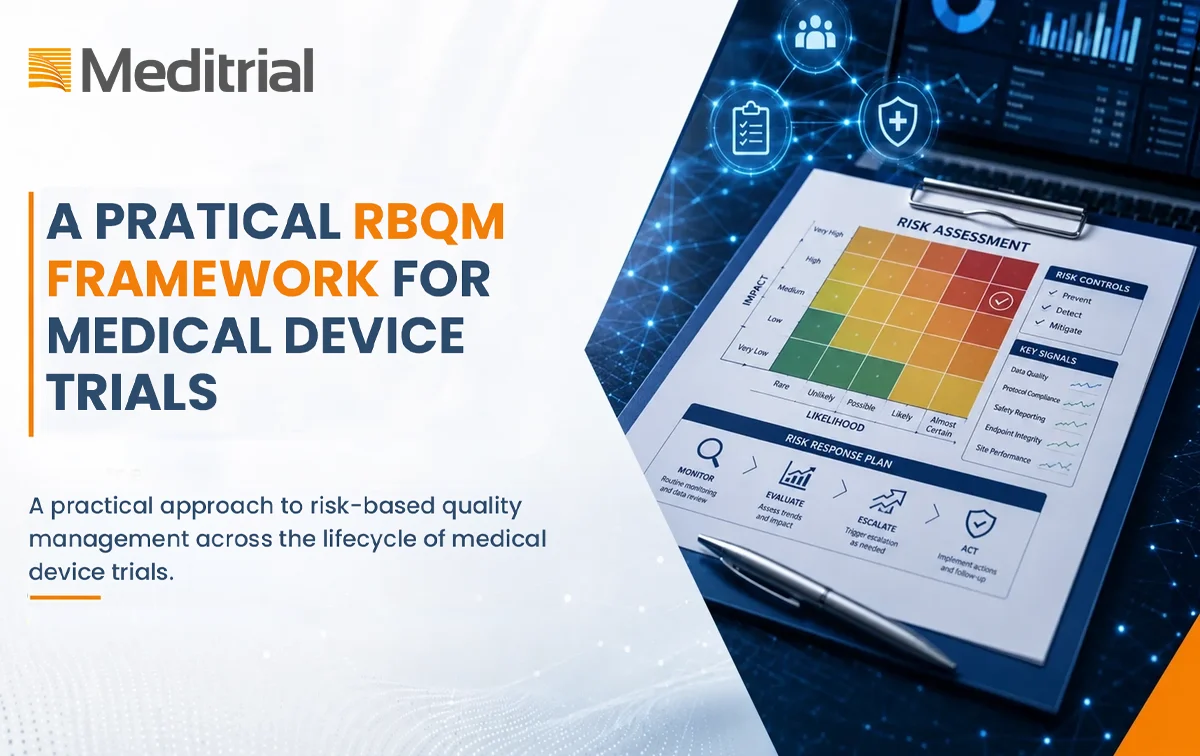
A Practical RBQM Framework for Medical Device Trials
Risk-based quality management for medical device trials, with practical actions for risk assessment, monitoring, data review, and trial oversight
EU Breakthrough Medical Devices Under MDCG 2025-9 (BtX)
EU breakthrough medical devices gain a clearer regulatory pathway under MDCG 2025-9, with early advice and lifecycle evidence planning
What Swissmedic Fast-Track Means for Clinical Trial Sponsors
Swissmedic swissethics Fast-Track Pilot Project accelerates eligible trial reviews and makes coordinated regulatory preparation increasingly important.
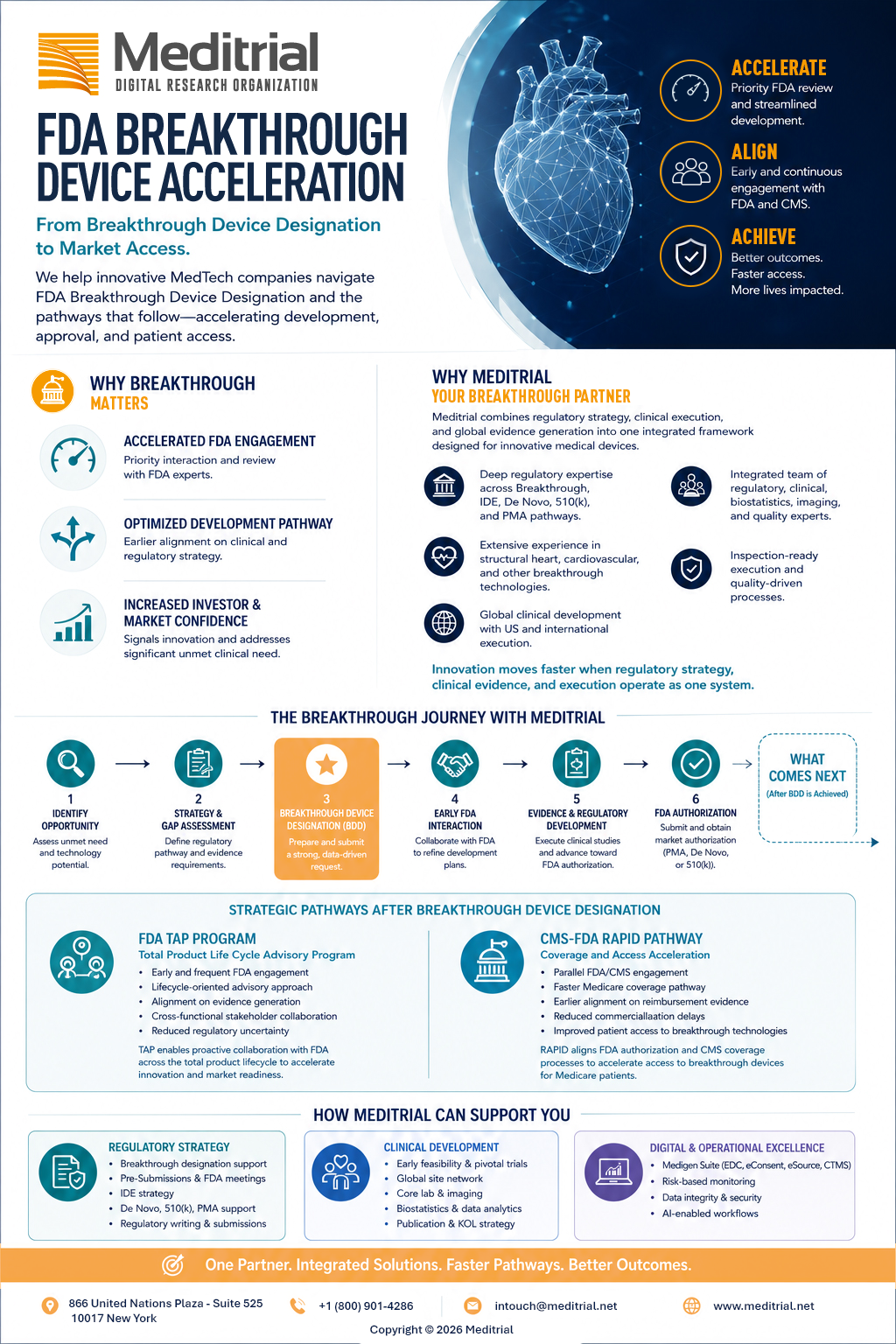
FDA Breakthrough Device Acceleration
How innovative MedTech companies can accelerate FDA approval, secure Medicare coverage, and reach patients faster—starting with Breakthrough Device Designation.

The contribution of patient associations in clinical trials
Historically, patient organizations have had the primary purpose of supporting the communities they represented. Today, this remains a crucial function, but modes have changed, as has the role that associations and patients themselves take on [...]
This article provides general information and does not constitute regulatory or legal advice. Requirements should be confirmed for the specific study, applicable regulatory framework, and markets concerned.